Cover
Govt must use windfall tax revenue for critical infrastructure projects-OAU Prof of Economic History
A Professor of Economic History at the Obafemi Awolowo University, Ile Ife, Adetunji Ogunyemi, speaks on the amendment of the Finance Act 2020 by the National Assembly to accommodate windfall levy on banks’ profits on foreign exchange transactions. The lawyer, public finance expert submits that the policy is perfectly in order, asking banks to see it as contribution to national development. Excerpts:
The windfall levy generated some debate in the polity with government justifying it as the right thing to do in order to strike a balance in the key sectors of the economy. How justified is this levy on banks’ foreign exchange gains?
Nigeria is currently in dire straits financially and generally speaking economically. It is within the power of the government of the Federation going by its stated exclusive jurisdiction in the First Schedule Part I of the constitution of the Federal Republic of Nigeria to make such laws and to direct such policies and actions as to ensure peace, good order and good government in Nigeria. Therefore, if Nigeria is in dire straits and some Nigerians, whether persons or bodies or corporate organisations, that have been feeding fat on the system, especially when that feeding fat is not directly a function of their own productive energies, then it behoves the Federal Government to ensure a balancing of duties and responsibilities within the system such that a resource-deficient sector of the economy can benefit from the resource-surplus part through what is called economic stabilisation. So, to me, it is perfectly in order to amend the Finance Act 2020 in order to accommodate the collection of this one-off levy on the windfall that the banks in the financial system have benefited from on foreign exchange transactions in the last one year. To me, it is perfectly in order and it is part of the duties of the government to stabilise the economy and also redistribute wealth.
Part of the arguments of those kicking against the policy is that allowing the windfall levy on banks may create uncertainty about the future as government may come with another windfall tax in some other sectors. Is this fear justified?
A situation of paralysis needs a shock therapy to bring it to normalcy. In 1929 up to 1932, there were decisions made in the United States under Herbert Hoover to stabilise the economy by ensuring that government deliberately pumps into the economy huge expenditure financed under public-private partnership arrangement. Nigeria is in such a situation now as the United States was under Hoover. So, it is not out of place to request that that banks that have made unplanned, spontaneous, unpredicted, sudden income to donate to the system a portion of their profits. This levy is actually on their windfall which is not part of their projections in their respective budgets. So, there is nothing that is malicious about this levy. After all, the levy is not for the benefit of persons. It is for the benefit of the public and it is in order.
Naturally, the Chartered Institute of Bankers of Nigeria (CIBN) has risen in defence of the banks to say asking them to pay a windfall levy amounts to double taxation because banks have already paid Companies Income Tax. What do you make of this argument?
I disagree absolutely with such stance from CIBN. What of the progressive deductions that the banks have been making with respect to ATM withdrawals by both the depositors and the withdrawers? Banks charge N20 per transaction and at times N50. Many of these deductions are actually illegal and the CBN should have asked them to return the money to their customers. These deductions run into billions of naira. But it would seem that the CBN did not want to rock the boat and has allowed the banks to earn some income for their stabilisation so that when a request for re-capitalisation would come, they would have something to use for that purpose. So, the banks can’t approbate and reprobate at the same time. They can’t be placing unlimited charges on their customers and expect government not to come in with a decision to stabilise the system. The windfall levy is a patriotic call made on the banks to contribute to the system. The banks should not see it as a tax. After all, it is a one-off levy. At any rate, why are the banks trying to shy away from their responsibility of contributing to the system? Their wealth comes from the commonwealth of Nigeria. Is that not? If your wealth comes from the commonwealth of a country and that country is in dire straits and it calls upon you to pay a levy on profits arising from your unpredicted income, I don’t think that it is out of place for them to obey such call to help fatherland.
Are there special benefits from a windfall tax?
The benefits are many. One, insofar as the government will not pump the revenue arising from this windfall levy on banks into the general budget, then there is no problem. But if government puts the revenue into the general budget and uses it to fund recurrent expenditure, that is going to be unacceptable. However, if government pumps the money from the windfall tax specifically into certain projects, for example, the Sokoto-Badagry Highway, the coastal road, the Port Harcourt-Maiduguri railway, etc, it is going to be absolutely correct. It can also be used for industrial development through the Bank of Industry or specifically into some agricultural projects such as dam development and so on. These are the specific areas the money can be channelled into. But I would advise that the government uses the revenue to fund critical projects such as the Lagos-Calabar Coastal road, the Sokoto-Badagry Highway, Port Harcourt-Maiduguri rail line, expansion of the standard gauge from Ibadan to Abuja and then onward to Kaduna. These are the critical projects that will create a trickle-down effect on the economy to jumpstart it from its doldrums and provoke productive enterprises among business concerns.
The three tiers of government have been smiling to the banks every month on account of huge revenue collected by the FederaI Inland Revenue Service (FIRS) for the Federation. Shouldn’t focus shift to the other two tiers of government who have been getting more money since the removal of petrol subsidy by President Bola Tinubu?
That is what we call financial injustice in the system.
Actually, many governors in Nigeria, maybe for political correctness, did not say much about the issue of workers conflicting with the Federal Government on the issue of minimum wage neither did they support the Federal Government to do at least some defence within the realm so that citizens will not be unnecessarily agitated and then begin disturbances. But the truth of the matter is that the respective governments of the states of the federation today are now earning at least 40 per cent more than what they were earning before. It behoves them to come forward to explain to Nigerians why some A, and B, C policies have been done in their favour by the Federal Government. For example, the removal of subsidy from petrol has helped states that were previously in debts like Osun State to begin to successfully and significantly exit those debts and be able to pay workers. But do they give the credit to the Federal Government? The answer is No. The states have been giving the credit to themselves as if they conjured up the fat allocations they are now getting. Whereas, we know it is directly as a result of the fact that the FAAC has been to get more money through removal of subsidy and the efficient revenue collection by FIRS. This is why the states have now been financially strong to do their capital projects. Some of these states are even doing a kind of subtle blackmail to give a dog a bad name in order to hang it. Otherwise, if your income has increased as a result of government policy, why can’t the states explain to their citizens and spend the money to make things better for the citizens in their respective states? They have put all the burden on the Federal Government. It is a shame.
Do you think the recent Supreme Court judgment which states that allocations should be paid directly into the accounts of local government areas will also help bring down tension and enhance development at the grassroots?
I support the Federal Government’s view, position and policy on this and for the Attorney General of the Federation to approach the Supreme Court for interpretation of the constitution and to make declarative orders. This is perfectly in order. This is actually how to govern a country. Do not forget that the local government councils in Nigeria are 768 and not 774. This is provided in Section 3 subsection 6 of the 1999 Constitution as amended. There six area councils in Abuja and if you add this number, you will get 774. But the area councils in Abuja are not local government councils.
The Supreme Court ruled on this in 2002 in the Attorney General of the Federation versus Attorney General of Abia State and 35 others. But let us not go there. The truth of the matter is that the 768 local government councils in Nigeria will now directly benefit from their allocations pursuant to Section 162 of the Constitution. The Supreme Court judgment is just half of the battle won. The other half of the battle to be won is to ensure that election into local government councils is not conducted by State Independent Electoral Commissions (SIECs). There should be an amendment to the Electoral Act for that purpose so that the same election will be conducted by INEC in order that there will be a level-playing field. The SIECs are actually not independent of the governors who appoint their officers. But it is a good thing that local governments are now going to get their allocations directly from FAAC beginning from this month, that is July.
Quote “The windfall levy is a patriotic call made on the banks to contribute to the system. The banks should not see it as a tax. After all, it is a one-off levy.”
Cover
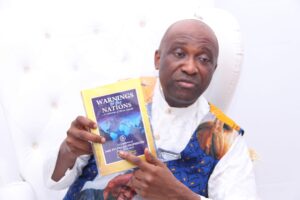
Kwara Monarch Kidnap: Primate Ayodele Warned But They Didn’t Listen
Oba Salman Aweda, his wife and another resident have been kidnapped emidnight invasion of Olayinka community in Ifelodun Local Government Area of Kwara State.He was recently elevated by the state government.The heavily armed gang stormed the palace of at about 1:40 a.m. on Saturday, firing sporadically to scare residents before taking him and two others to an unknown destination.This is the noise we have been making regarding how they treat the prophecy of Nigerian prophet, Primate Elijah Ayodele of INRI Evangelical Spiritual Church.Before now, people used to say Primate Ayodele talks about politics alone but at the moment, his prophecies about insecurity in the country has been top notch; nobody comes close if we are to rank it but it is alarming that people who are supposed to secure people have turned deaf ears.This has repeated itself several times and it seems the time has come for us to ask questions; do our security operatives enjoy hearing the death and kidnap of innocent Nigerians let alone prominent individuals?Before the recent attacks on military base, an ondo monarch, bomb attacks in Borno, attack on church on Easter Sunday, Primate Ayodele specifically warned the security operatives and the government about the impending attacks but they never listened. Now, few weeks ago, Primate Ayodele revealed that next target of terrorist in Nigeria and stated that they are planning to attack some traditional rulers. He even went as far as revealing the states where the attacks would be carried out.These were his words:“Terrorists will start kidnapping traditional rulers in some states that include Kebbi, Niger, Zamfara, Kano, Kogi (Lokoja axis), Ondo, Kwara, Akwa Ibom, Ebonyi and Yobe, with concerns that the threat could also extend to the Federal Capital Territory, Abuja.”The happening in Kwara state has fulfilled this prophetic warning. Obviously our security operatives didn’t do anything about it. Now, how long do we continue like this?
Cover
How Tinubu’s Government Is Suffering For Ignoring Primate Ayodele’s Early Prophecies On Insecurity
After swearing-in on May 29, 2023, President Bola Ahmed Tinubu received goodwill messages from renowned men of God, with many prophesying that his administration would be better, especially in terms of security.
Many of these messages were based on the earlier promise of the All Progressive Congress that the Vice President, Kashim Shettima, would tackle insecurity adequately for the country.
However, in the midst of these praises and goodwill messages, renowned prophet, Primate Elijah Ayodele, who is known for always revealing the future of any new administration, spoke in a prophetic message that went viral, that insecurity will be used as a great tool against Tinubu’s administration.
The prophet had been talking about another APC government since 2022, noting that Nigerians will face several economic hardships, and he was detested by the ruling party and its supporters because of this. They saw him as an opposition party when they were supposed to listen to his prophetic warnings. However, it happened; the major indices of the economy are energy and currency. The exchange rate and price of petrol have never been so much like it has been for the past three years now.
The prophet warned repeatedly that insecurity and the economy would be the major issues President Tinubu would face in his administration, but did they listen? Absolutely not, because if they did, some of the issues being faced in the country would have disappeared.
Beyond his statement before the election, Primate Ayodele continued to warn the government against insecurity, even as far as warning against an impending coup. The prophet had revealed that some powerful Nigerians are angry with the president and have planned to remove him unconstitutionally. Of course, they never believed this till it happened. If not for the prophetic security alert issued by the prophet, the president may have been removed when the coup came to light.
These were his warnings regarding the coup:
“There will be an attempt to unseat Tinubu unconstitutionally; the NSA, DSS, and Chief of Army Staff must be careful about this. There are some gangs planning between November to January to unseat him.”
Thankfully, they were arrested, and some of them have been detained.
More recently, there were attacks on some states on Easter Sunday, leading to the death of some Christians. This happened as a result of obstinacy on the part of security operatives because just days before it, Primate Ayodele specifically warned that some states would be attacked from Easter Sunday, and it did happen, with security operatives having nothing to do to stop the incident.
These were Primate Ayodele’s warnings.
“Our security operatives must watch Easter Sunday well because plans have been concluded to carry out attacks in seven states starting from that day.
“The states to watch out for include Kogi, Kwara, Ondo, Ogun, Nasarawa, Kebbi, and Kaduna.
“The security operatives must be extra vigilant in these states starting from Easter Sunday.”
Yesterday, there was an internal memo released by the Nigerian Customs Service that Boko Haram are planning to attack some prisons and airports in the country.
This corroborated the prophetic warning of Primate Ayodele, which he shared some weeks ago, regarding some prisons, specifically mentioning Kuje prison.
These were his words:
“Break jail is imminent, Kuje prison or they send a bomb into Kuje prison, it’s a midnight work…..”
Meanwhile, Primate Ayodele had warned that there are people sponsoring insecurity in President Tinubu’s government. He also urged him to name some of them in order to curb it, but this has yet to be done.
President Tinubu’s government would have been one of the best, but insecurity has tarnished it greatly, and the country is gradually returning to the days of daily killings; even Nigerian high-ranking soldiers are not spared. This insecurity has given the administration a bad record internationally, with the US naming Nigeria as a Country of Particular Concern (CPC).
If the president had listened, Nigerians, and even the government, wouldn’t have suffered this much. However, it’s not too late for them to turn a new leaf.
Cover
Building Systems that outlive Founders – Bidemi Oke
There is a quiet misconception in many growing companies that vision alone is enough to sustain momentum. Founders are often the engine because they are decisive, driven and deeply involved. But what happens when the engine steps back?That question is where real companies are separated from fragile ones. Building something that outlives a founder is not about removing their influence; rather, it is about translating that influence into systems, repeatable, observable and transferable structures that do not rely on constant presence. Without this, growth becomes personality-dependent, and scale becomes inconsistent.At the early stage, founder-led execution works. Decisions are faster, direction is clearer, and there is less friction. But as the company grows, that same model becomes a bottleneck. Every approval, every escalation, every strategic shift begins to orbit one person. The business does not slow down because of external pressure; it slows down because its internal architecture cannot carry its own weight.Usually, “system” is often misunderstood. It is not just about tools, dashboards or policies. It is about designing how decisions are made, how information flows and how accountability is structured. It is about making sure that the logic behind actions is visible, not assumed.For example, a strong system answers questions before they become problems. What triggers a decision? Who owns it? What data informs it? What happens if it goes wrong?When these are unclear, teams default to escalation. When they are clear, teams operate with autonomy.This is where many founders hesitate. System-building feels like losing control. In reality, it is the only way to extend control without being physically present. It shifts leadership from being reactive to being embedded.One of the most overlooked aspects of building enduring systems is Documentation.Now, not as a formality but as a strategic asset. Decisions that are not documented become opinions. Processes that are not documented become inconsistent.Over time, this creates invisible friction. Teams solve the same problems repeatedly but differently each time.Documentation, when done well, becomes institutional memory. It ensures that the company remembers even when individuals move on.Another critical layer is Feedback Loops. Systems should not be static; they must evolve with the business. This requires structured ways to capture what is working, what is failing and what needs refinement. Without feedback loops, systems become outdated. With them, systems become adaptive.There is also a cultural dimension to it. Systems do not operate in isolation; people execute them. If the culture rewards speed over clarity, systems will be bypassed. If the culture values accountability, systems will be strengthened. The goal is alignment where systems reinforce behaviour and behaviour reinforces systems.In fast-moving industries, this becomes even more important, take fintech, for instance. The pace of regulatory change, market volatility and user expectations demands consistency under pressure.Companies that rely solely on founder instinct struggle to keep up, while those that invest in structured decision-making, risk management frameworks, and operational clarity are better positioned to adapt.This is something we are increasingly seeing in companies like FlashChange, where the focus is not just on growth, but on building operational resilience. The emphasis is shifting from “who is making the decision” to “how decisions are made.” That shift, while subtle, is very powerful. It creates a foundation that can support scale without losing direction.Ultimately, building systems that outlive founders is about redefining leadership. It is not measured by how many decisions a founder makes, but by how many decisions the organisation can make without them.The strongest companies are not those where the founder is always present. They are the ones where the founder’s thinking is quietly embedded, shaping actions, guiding priorities and influencing outcomes, even in their absence. That is how legacies are built.Not through constant control, but through systems that carry intent forward.About the AuthorBidemi Oke is the Chief Executive Officer of FlashChange, a fintech platform focused on secure digital asset exchange. He is an entrepreneur and vibrant leader, recognised for driving innovation and redefining access in the financial technology industry.
-
Banking and Finance5 hours agoWema Bank Meets Central Bank of Nigeria’s Recapitalisation; Retains National Banking License
-
Business and Brand5 hours agoVerve Partners NEXO Standards Community, PCI Security Standards Council To Secure Global Interoperable Payments
-
Cover1 day agoKwara Monarch Kidnap: Primate Ayodele Warned But They Didn’t Listen
-
Banking and Finance1 day agoBanking the Economy That Actually Exists
-
Entertainment5 hours agoPremium Entertainment Without the Premium Price Tag