
Business
10 Takeaways from Seven-Up Bottling Company’s SMEs Bootcamp


Seven-Up Bottling Company, in partnership with Zenith Bank and the United Nations Industrial Development Organization (UNIDO), recently organised a two-day Scale-Up Bootcamp for small and medium-sized enterprises, to provide them with needed information and strategies to scale up their businesses.The two-day session saw the Chief Executive Officers of 80 SMEs benefit from the growth experience of experts such as the Managing Director of Seven-Up Bottling Company, Ziad Maalouf, and GM of Marketing Seven-Up Bottling Company, Segun Ogunleye. The bootcamp also had impactful sessions facilitated by the GDM, Zenith Bank’s Head of Retail Banking, Lanre Oladimeji; National Director, UNIDO, Oluyomi Banjo; former Chief Executive Officer, the Federal Competition and Consumer Protection Agency, Babatunde Irukera, and the Founder, Thrive HR, Adeshola Aliogo Scale-Up Bootcamp 1.0 provided attendees with the requisite corporate, people management, and financial management strategies crucial for scaling. Below are ten key insights from the bootcamp:Identify your ‘sweet spot’: According to Ziad, a business aiming to scale must have the right combination of experience, passion and value to meet a global need. This combination provides the sweet spot. Ziad advised entrepreneurs that if their current business fails to match all three aspects, reconsideration is needed. Loan access tips: Presenting tips on how businesses can boost their chances of accessing loans from financial institutions, the Zenith Bank Head of Retail Banking, Lanre Oladimeji, said business owners need to be conversant with the five Cs of credit and know that character is key to accessing loans. He said, “SMEs must have a business continuity and succession plan and know the type of funding available to businesses in their sector.” He further explained that to access loans, “an applicant needs to help the banker understand the business and explore the options they provide to support the business. Make every effort to service existing loan obligations. If loans go bad, stick with your bank and work out a remediation plan. In this digital era, there is no running away when a loan goes bad.”Fear breeds errors: Entrepreneurs were also cautioned on the need to understand that employees will make mistakes and must learn how to manage people when such occurs. According to Aliogo, zero tolerance for error breeds error. When people are too afraid, they won’t try new things and growth won’t happen. Hence, entrepreneurs are advised to make their team learn from mistakes and become better.Team evaluation and incentives are crucial: While fresh and quality recruitment might be needed to drive business growth, there is also the need for critical evaluation of the team. According to Ziad, there’s a need to evaluate the team based on performance and value. Those below average should be allowed to go and the average and high performance should be motivated. “Create a performance and incentive framework. The majority of employees are not motivated by salary. Convert your employees to shareholders with incentives for performances and watch that team you think is average produce results that scale your business,” he said.Wrong recruitment costs more: In her people management session, Founder, Thrive HR Nigeria, Adeshola Aliogo, said employee engagement is a major growth driver for enterprises. She described engagement as the level of enthusiasm and dedication a worker feels towards their job. She said this occurs when employees find MAGIC – Meaning, Autonomy, Growth, Impact, and Connection in the business. She advised that entrepreneurs should set their value standards, and then find workers with the same level of enthusiasm and who understand how everything they do ties to the growth of the business. “The cost of not hiring right is more,” she stressed.Look-alike recruitment breeds stagnation: to scale your business, you need to have the right combination of people. To have the right mix, entrepreneurs should avoid the lookalike requirement trap. To drive business growth, a SABI(Strive, Accountability, Bonding and Innovation) formula was recommended for SMEs. The team should consist of stivers who get things done, the accountable ones with strict adherence to processes; the social ones and innovators who are the ideation hub of the business. SME funding opportunity at UNIDO: National Director, UNIDO, Oluyomi Banjo, at the bootcamp, announced that UNIDO is committed to advancing Sustainable Development Goal Number 9, which advocates industry, innovation, and infrastructure in Nigeria through its various initiatives such as the Global Cleantech Innovation Programme. He said participants who own waste recycling businesses, and others who fit into the sustainability space, should take advantage of the GCIP, to access business support for scale-up.Increase willingness to pay: This is tied to creating value that will make the customer want to pay more for your product or service. Maalouf said businesses willing to scale must provide functional, social, and emotional value. “What many entrepreneurs don’t know is that customers are willing to pay more if you offer the value. This is what gives an edge over a competitor. When you have the value that the world needs, customers will neglect other products for yours.”Regulation rewards innovation: former Chief Executive Officer, the Federal Competition and Consumer Protection Agency, Babatunde Irukera, while explaining the regulatory framework to attendees, noted that regulation is an existential threat to businesses worldwide. He however stressed that without regulation, SMEs won’t have a level playing field to survive and scale. Regulation secures everyone. Your businesses won’t grow if there is no regulator to check competition. It is important to keep everyone accountable to certain standards,” he said. He enjoined entrepreneurs visualize their growth and understand the regulatory scope within their business space. Explore incremental and architectural ideas: Entrepreneurs don’t necessarily need radical ideas to scale. Value doesn’t always revolve around novelty and disruption. Improving an existing product or service to make them better, faster, or cheaper is another route to scaling. You can also apply existing ideas or technology to new areas to create value for growth.

African Marketplace (AMP) is set to return for its highly anticipated second edition from October 10–12, 2026, at the prestigious Conrad Hotel Dubai, following the success of its landmark 2025 debut. The three-day event will once again convene some of the finest products, services, creatives, and innovators from Africa and the Caribbean, connecting them with global buyers, investors, policymakers, distributors, and cultural enthusiasts in one of the world’s most strategically connected trade capitals.African Marketplace is a pan-continental trade and cultural platform designed to spotlight Africa’s and the Caribbean’s finest export-ready brands, SMEs, and innovators, empowering them to scale internationally, unlock investment opportunities, and achieve global relevance. African Marketplace 2026 will showcase the richness of African and Caribbean heritage alongside contemporary innovation across fashion, furniture, art, cuisine, music, technology, wellness, and intellectual capital.Speaking on the announcement, Ibukun Awosika, Founder of African Marketplace and the Ibukun Awosika Leadership Academy (IALA), said: “African Marketplace 2025 was proof of concept. What the world witnessed in Dubai was not potential, it was excellence in full expression.” “For 2026, we are going even further. We are building on that foundation with greater scale, sharper commercial focus, and an even stronger declaration that Africa and the Caribbean are not waiting to be discovered. We are here. We are globally ready. And we are building our own tables. Dubai is where we invite the world to experience who we truly are.” She added.Through curated exhibitions, business networking, investment conversations, cultural showcases, and strategic partnerships, African Marketplace continues to position itself as a leading platform connecting Afro-Caribbean excellence to global opportunity. More than an exhibition, AMP serves as both a commercial gateway and cultural platform; creating meaningful opportunities for trade, investment, collaboration, and cross-cultural exchange on a global scale.As the platform grows year after year, AMP remains committed to building a lasting ecosystem where commerce, culture, innovation, and identity converge.EXHIBITOR REGISTRATION IS NOW OPENBusinesses, investors, partners, and attendees interested in participating in African Marketplace Dubai 2026 can learn more at:www.theafricanmarketplace.orgFor media inquiries, sponsorship opportunities, or partnership proposals, please contact:info@theafricanmarketplace.orgAbout African MarketplaceAfrican Marketplace (AMP) is a pan-African trade and culture platform connecting Africa and the Caribbean to global markets through commerce, creativity, innovation, and strategic partnerships. Hosted annually in Dubai, AMP provides export-ready businesses and entrepreneurs with access to international visibility, investment opportunities, and global networks.
Business
UAE’s Exit from OPEC: Eroding Pricing Power, Saudi Arabia’s Response, and the Implications for Nigeria

By Uwadiae Osadiaye, Head of Alternative Investments, FirstCap Limited
In a move that has sent ripples through global energy markets, the United Arab Emirates (UAE) announced on April 28, 2026, that it will formally withdraw from the Organization of the Petroleum Exporting Countries (OPEC) and the broader OPEC+ alliance effective May 1. The UAE, one of OPEC’s largest and most capable producers with output around 3.2–3.6 million barrels per day (bpd) and significant spare capacity, cited national interests and the need for production flexibility amid the ongoing energy crisis linked to Iran-related disruptions.This departure marks a historic fracture in the nearly 60-year-old cartel and follows precedents like Angola’s 2024 exit over quota disputes. For Nigeria, Africa’s largest oil producer and a longtime OPEC member, the implications centre on weakened cartel cohesion, diminished pricing power, and direct pressure on revenues.Impact on Oil Prices and OPEC Pricing PowerFree from quotas, the UAE is expected to ramp up production toward 5 million bpd. While current supply disruptions may limit the immediate effect, the added volume will exert downward pressure on prices and increase volatility in the medium to long term. Analysts point to potential declines of $5–7 per barrel once markets normalize.More critically, the exit undermines OPEC’s core pricing power. The UAE brought meaningful spare capacity; its departure leaves Saudi Arabia carrying a heavier burden for any future production cuts needed to stabilize prices. This makes defending price levels more costly and less effective for the Kingdom.Saudi Arabia’s Response: A Strategic Setback and Managed RiftSaudi Arabia, OPEC’s de facto leader, regards the UAE exit as a significant blow to its influence. Riyadh has kept public reactions measured, emphasising the resilience of deep trade, investment, and logistical ties between the two economies. Analysts note that a full economic rupture would harm both sides and is unlikely amid shared regional threats. Behind the scenes, however, the move exposes and widens longstanding rifts over oil quotas, Yemen, Sudan, and regional influence. It forces Saudi Arabia to shoulder more of the stabilisation burden alone, weakening its ability to enforce discipline across the group. The exit is seen as the UAE asserting autonomy and rejecting Saudi-led oil governance. A recent Gulf summit was described positively by UAE officials, indicating efforts to contain fallout.This response highlights Saudi Arabia’s recalibration: maintaining core OPEC leadership while adapting to a less reliable alliance structure. It may push Riyadh toward more unilateral production decisions or tighter coordination with remaining compliant members.Domino Risks and Further Erosion of InfluenceVenezuela, with vast reserves and recovering output, emerges as a potential next candidate for greater independence or even exit, alongside other quota-frustrated producers. A cascade of departures could render OPEC largely symbolic, leaving global oil prices driven primarily by market forces rather than coordinated cuts. This would likely result in a structurally lower price floor and higher volatility.Direct Effects on NigeriaNigeria remains heavily dependent on oil for export earnings and government revenue. With production often falling short of its ~1.5 million bpd OPEC quota (recent figures around 1.38 million bpd amid theft, vandalism, and infrastructure issues), the country has limited ability to offset price weakness through higher volumes.Softer prices or sustained volatility would widen fiscal deficits, pressure the naira, and complicate budgets benchmarked around $65–70 per barrel. Angola’s experience showed that quota freedom alone does not guarantee production gains when structural problems persist- Nigeria risks similar constraints. A weaker OPEC, with reduced Saudi leverage to enforce discipline, further diminishes the “price floor” protection African producers have relied upon.In this environment, Nigeria’s longstanding challenges – upstream security, investment attraction, and economic diversification – become even more urgent. While the country has reaffirmed commitment to OPEC, the cartel’s diminishing pricing power (exacerbated by the Saudi-UAE rift) means future revenue stability cannot be taken for granted.Outlook: Navigating a More Fragmented Oil Order The UAE’s exit, Saudi Arabia’s measured but strained response, and the resulting erosion of OPEC cohesion signal a structural decline in the cartel’s pricing influence and a more market- driven oil era. For Nigeria, this heightens fiscal and currency risks tied to its oil dependence while underscoring the limits of relying on collective producer power.In the short term, elevated prices from geopolitical disruptions may provide a temporary buffer. Over the medium to long term, however, increased supply from the UAE (and potentially others) combined with weaker coordination could sustain volatility and a softer price environment. Saudi Arabia’s heavier stabilisation role may lead to more pragmatic quota adjustments or unilateral actions, but it also risks exposing fractures that smaller members like Nigeria cannot easily exploit.ConclusionNigeria’s path forward requires decisive action. Upstream priorities should include intensified security operations against oil theft, accelerated infrastructure upgrades, and targeted incentives to attract investment – addressing the chronic underproduction that has left the country unable to capitalise on quota flexibility. Downstream and diversification efforts remain critical: expanding refining capacity, developing gas resources, and growing non-oil sectors (agriculture, manufacturing, and services) will reduce vulnerability to crude price swings.Diplomatically, Nigeria must engage actively within a diminished OPEC, potentially advocating for more flexible arrangements that reflect African producers’ realities. Broader economic reforms—fiscal discipline, improved revenue management, and naira stability measures—will determine whether external shocks translate into crises or catalysts for resilience.Ultimately, the Gulf realignment and OPEC’s evolution present Nigeria with both risks and opportunities. In a world where oil market power is fragmenting, proactive domestic transformation offers the most reliable route to energy security and sustainable growth. The coming months will test whether Nigerian policymakers seize this moment or allow it to deepen existing vulnerabilities.FirstCap Limited is a dynamic investment banking and capital markets advisory firm, and a subsidiary of First HoldCo Plc, one of Africa’s most resilient and trusted financial institutions. With over two decades of experience delivering tailored financial solutions that drive growth, transformation, and long-term value. Our core expertise spans mergers and acquisitions, capital raising, and strategic financial advisory. Backed by a proven record of landmark transactions across multiple sectors, We are a trusted partner of choice for corporations, institutions, and entrepreneurs navigating complex financial landscapes.https://firstcapltd.com/
Business
FIRSTCAP CLOSES N4.46BN LAPO MFB SPV PLC SERIES 1 BOND, DEEPENS ACCESS TO LONG TERM CAPITAL
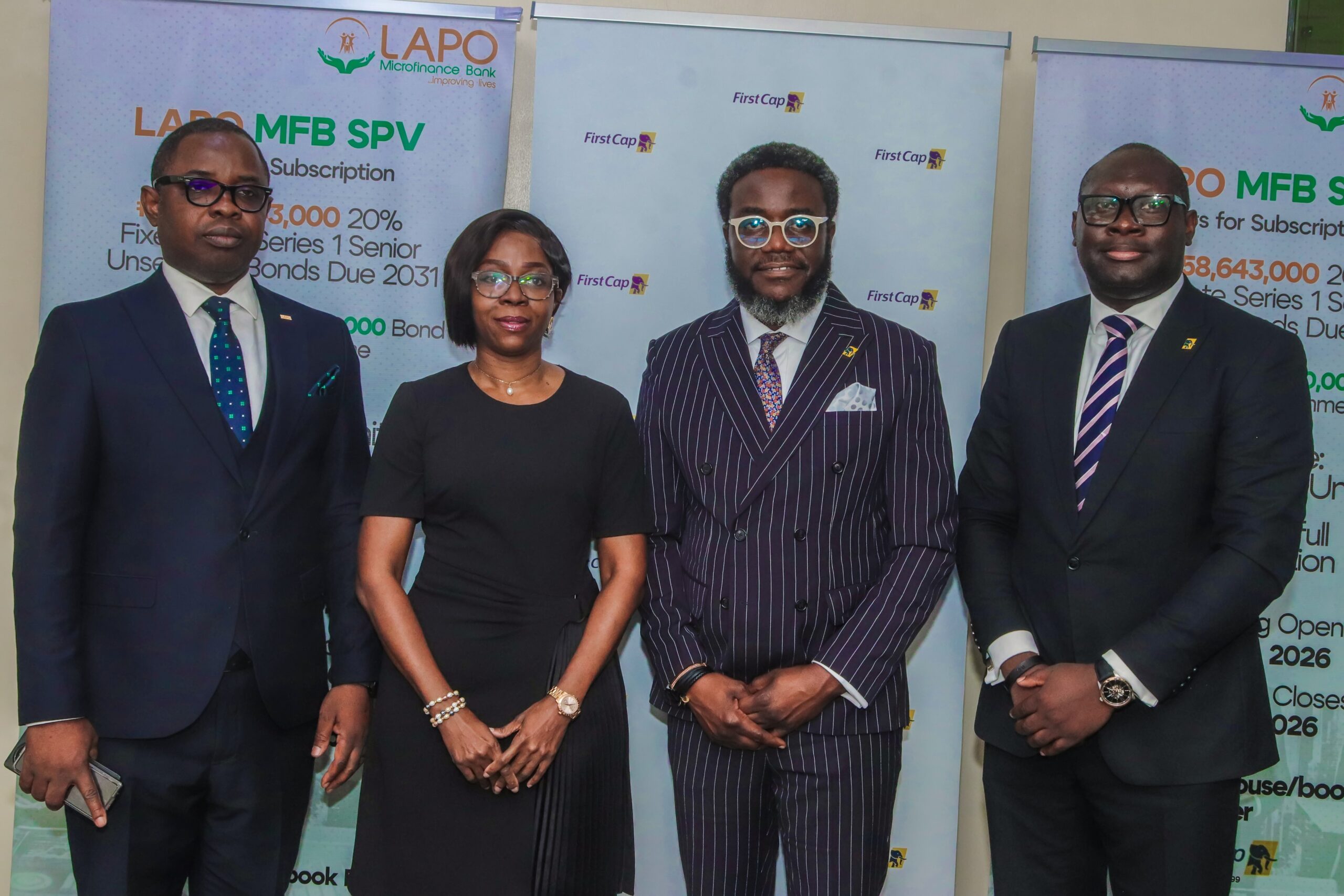
IMG_5294 L-R: Chief Finance Officer, LAPO Microfinance Bank, Emmanuel Igiehon; Managing Director, LAPO Microfinance Bank, Cynthia Ikponmwosa; Managing Director, FirstCap Limited, Ukandu E. Ukandu, and Head of Capital Markets, FirstCap Limited, Oluseun Olatidoye, at the LAPO MFB SPV Plc Series 1 Bond Issuance Signing Ceremony recently held in Lagos.
Lagos, Nigeria – April 2026 — FirstCap Limited, a leading investment banking firm and subsidiary of FirstHoldCo Plc., has successfully closed the ₦4.46 billion Series 1 Bond Issuance by LAPO MFB SPV Plc, reinforcing its strong leadership in Nigeria’s debt capital markets and deepening access to long term funding for high impact sectors.Acting as Lead Issuing House, FirstCap structured the fund raising on behalf of LAPO MFB SPV Plc (a company sponsored by LAPO Microfinance Bank Limited to mobilise institutional capital targeted at SME financing, renewable energy expansion, and digital financial services, three critical drivers of inclusive and sustainable economic growth in Nigeria.The transaction is underpinned by a compelling impact thesis, with proceeds strategically deployed to support small businesses and clean energy initiatives. The microfinance sector continues to demonstrate resilience and strong fundamentals positioning the issuance at the intersection of growth, sustainability, and financial inclusion.Commenting on the transaction, Ukandu E. Ukandu, Managing Director, FirstCap Limited, said:
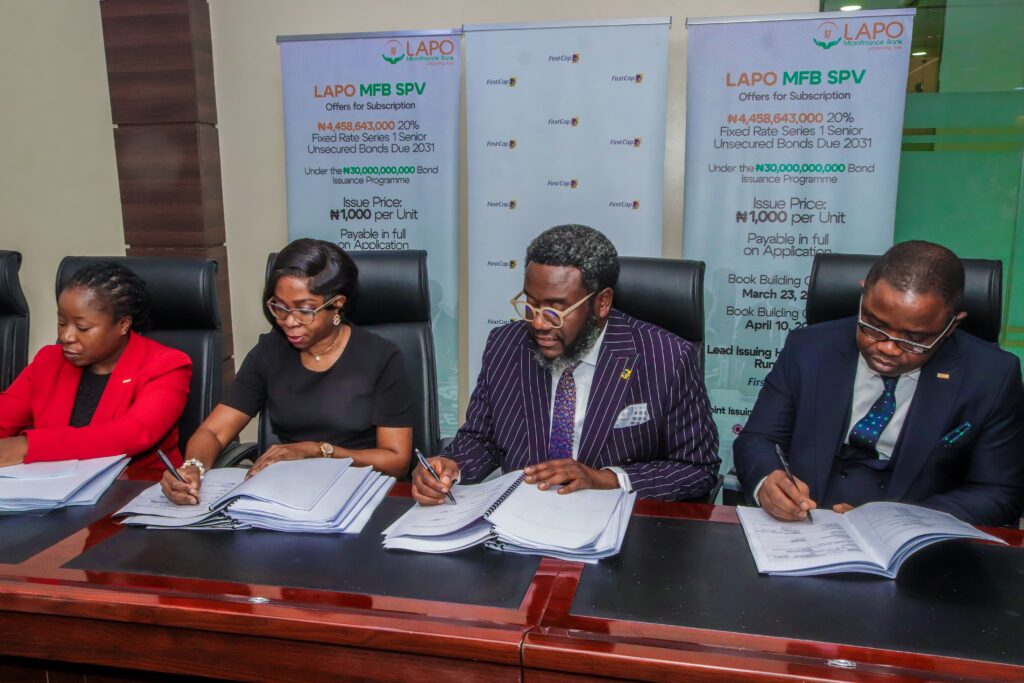
L- R: Company Secretary, LAPO Microfinance Bank, Peggy Idehoy; Managing Director, LAPO Microfinance Bank, Cynthia Ikponmwosa; Managing Director, FirstCap Limited, Ukandu E. Ukandu; Chief Finance Officer, LAPO Microfinance Bank, Emmanuel Igiehon, at the LAPO MFB SPV Plc Series 1 Bond Issuance Signing Ceremony recently held in Lagos.
“This successful issuance underscores our strategic commitment to directing capital where it delivers measurable economic impact. At FirstCap, we partner with institutions that have the scale, discipline, and vision to transform markets, and LAPO exemplifies these qualities.The ₦4.46 billion bond is positioned to be a catalyst for SME growth, expanded energy access, and broader financial inclusion. We remain committed to structuring transactions that are not only bankable, but impactful and aligned with Nigeria’s long term economic trajectory.”FirstCap Limited remains committed to leading from the forefront of Nigeria’s capital markets, structuring transactions that are bankable, impactful, and investable, while supporting the future trajectory of Nigeria’s economic development.”


Governor Dauda Lawal names executive secretaries for two agencies, appoints ZACADEP coordinator

Fidelity Bank Reaffirms Support for MSMEs, Drives Growth Agenda at SME Forum

Watching BBN and the World Cup Is No Longer a Location Thing
Regberegbe 1986, 87 and 88 Appoints Deputy Speaker As Adviser Okunrin

9mobile, Kantar Discuss Building Impactful Brands for the Future
dLocal Enables Payments from Verve Cards and Tokens for Global Merchants
-

 Brand1 day ago
Interswitch Brings Two Decades of Infrastructure Thinking to the 3rd ‘Invest Lagos’ Summit, highlights Lagos SHIP as prime example of forward-thinking public-private sector partnership
-
 Brand1 day ago
Watching BBN and the World Cup Is No Longer a Location Thing
-
 NEWS8 hours ago
Governor Dauda Lawal names executive secretaries for two agencies, appoints ZACADEP coordinator
-
 Banking and Finance1 day ago
Fidelity Bank Reaffirms Support for MSMEs, Drives Growth Agenda at SME Forum