
Cover
Nigeria @ 65: “We Are Not Better, Our Independence Is Like Bondage” – Primate Ayodele

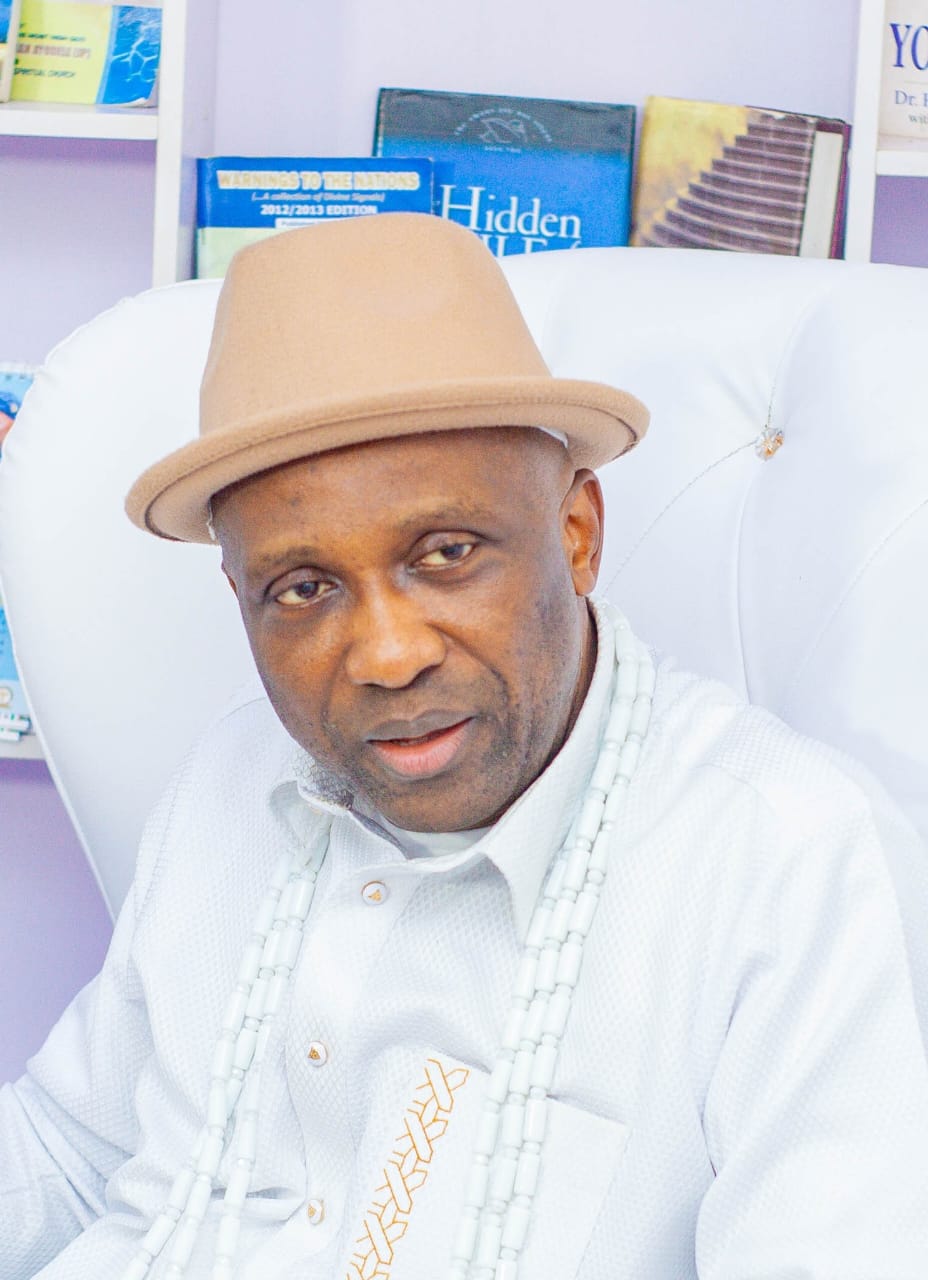
The Leader of INRI Evangelical Spiritual Church, Primate Elijah Ayodele, has expressed dissatisfaction with the state of Nigeria’s independence, describing it as another means of bondage.
In a statement signed by his media aide, Osho Oluwatosin, Primate Ayodele stated that the country has not become better and that people who fought for the nation’s independence have not been fully appreciated.
He stated that there are several differences in the country on different grounds, most especially politically, which have not allowed Nigeria to experience what it means to be independent
“At 65, we are still not better; those who fought recklessly for our independence have not been fully appreciated. They need to be appreciated by Nigeria getting united, but as it stands, we are not yet fully independent because of our several differences as a nation, especially politically. “
“Our independence is bondage for us; we are in a serious situation where there is no rest of mind and peace, for how long do we continue to pass through all of these?”
He frowned at people ruling the country the way they want it, which includes not appreciating those who worked tirelessly for where the country is at the moment.
“It’s unfortunate that the country is being run just the way people want; leaders are not appreciated, and people who have worked tirelessly have not been allowed to gain ground.”
Furthermore, he advised Nigerian leaders to work on five major things for the nation to experience what it means to be independent. He noted that the nation is sitting on a time bomb due to the issues in the country involving citizens.
“These are the five things we need to work on as we clock 65 we need to work insecurity, increase in production, utilisation of our mineral resources, agriculture and true federalism. It would be a fantastic independence.
“A lot of people are praying for separation; they have seen the government as without direction, there is tribal war, and I doubt if we are improving because we are not committed. Nigeria is in a very difficult independence moment, and we are sitting on a time bomb.”

There is a quiet misconception in many growing companies that vision alone is enough to sustain momentum. Founders are often the engine because they are decisive, driven and deeply involved. But what happens when the engine steps back?That question is where real companies are separated from fragile ones. Building something that outlives a founder is not about removing their influence; rather, it is about translating that influence into systems, repeatable, observable and transferable structures that do not rely on constant presence. Without this, growth becomes personality-dependent, and scale becomes inconsistent.At the early stage, founder-led execution works. Decisions are faster, direction is clearer, and there is less friction. But as the company grows, that same model becomes a bottleneck. Every approval, every escalation, every strategic shift begins to orbit one person. The business does not slow down because of external pressure; it slows down because its internal architecture cannot carry its own weight.Usually, “system” is often misunderstood. It is not just about tools, dashboards or policies. It is about designing how decisions are made, how information flows and how accountability is structured. It is about making sure that the logic behind actions is visible, not assumed.For example, a strong system answers questions before they become problems. What triggers a decision? Who owns it? What data informs it? What happens if it goes wrong?When these are unclear, teams default to escalation. When they are clear, teams operate with autonomy.This is where many founders hesitate. System-building feels like losing control. In reality, it is the only way to extend control without being physically present. It shifts leadership from being reactive to being embedded.One of the most overlooked aspects of building enduring systems is Documentation.Now, not as a formality but as a strategic asset. Decisions that are not documented become opinions. Processes that are not documented become inconsistent.Over time, this creates invisible friction. Teams solve the same problems repeatedly but differently each time.Documentation, when done well, becomes institutional memory. It ensures that the company remembers even when individuals move on.Another critical layer is Feedback Loops. Systems should not be static; they must evolve with the business. This requires structured ways to capture what is working, what is failing and what needs refinement. Without feedback loops, systems become outdated. With them, systems become adaptive.There is also a cultural dimension to it. Systems do not operate in isolation; people execute them. If the culture rewards speed over clarity, systems will be bypassed. If the culture values accountability, systems will be strengthened. The goal is alignment where systems reinforce behaviour and behaviour reinforces systems.In fast-moving industries, this becomes even more important, take fintech, for instance. The pace of regulatory change, market volatility and user expectations demands consistency under pressure.Companies that rely solely on founder instinct struggle to keep up, while those that invest in structured decision-making, risk management frameworks, and operational clarity are better positioned to adapt.This is something we are increasingly seeing in companies like FlashChange, where the focus is not just on growth, but on building operational resilience. The emphasis is shifting from “who is making the decision” to “how decisions are made.” That shift, while subtle, is very powerful. It creates a foundation that can support scale without losing direction.Ultimately, building systems that outlive founders is about redefining leadership. It is not measured by how many decisions a founder makes, but by how many decisions the organisation can make without them.The strongest companies are not those where the founder is always present. They are the ones where the founder’s thinking is quietly embedded, shaping actions, guiding priorities and influencing outcomes, even in their absence. That is how legacies are built.Not through constant control, but through systems that carry intent forward.About the AuthorBidemi Oke is the Chief Executive Officer of FlashChange, a fintech platform focused on secure digital asset exchange. He is an entrepreneur and vibrant leader, recognised for driving innovation and redefining access in the financial technology industry.
Cover
PFL AFRICA TO BRING THE LARGEST MMA EVENT TO WEST AFRICA WITH HISTORIC NIGERIA DEBUT IN LAGOS ON JUNE 13
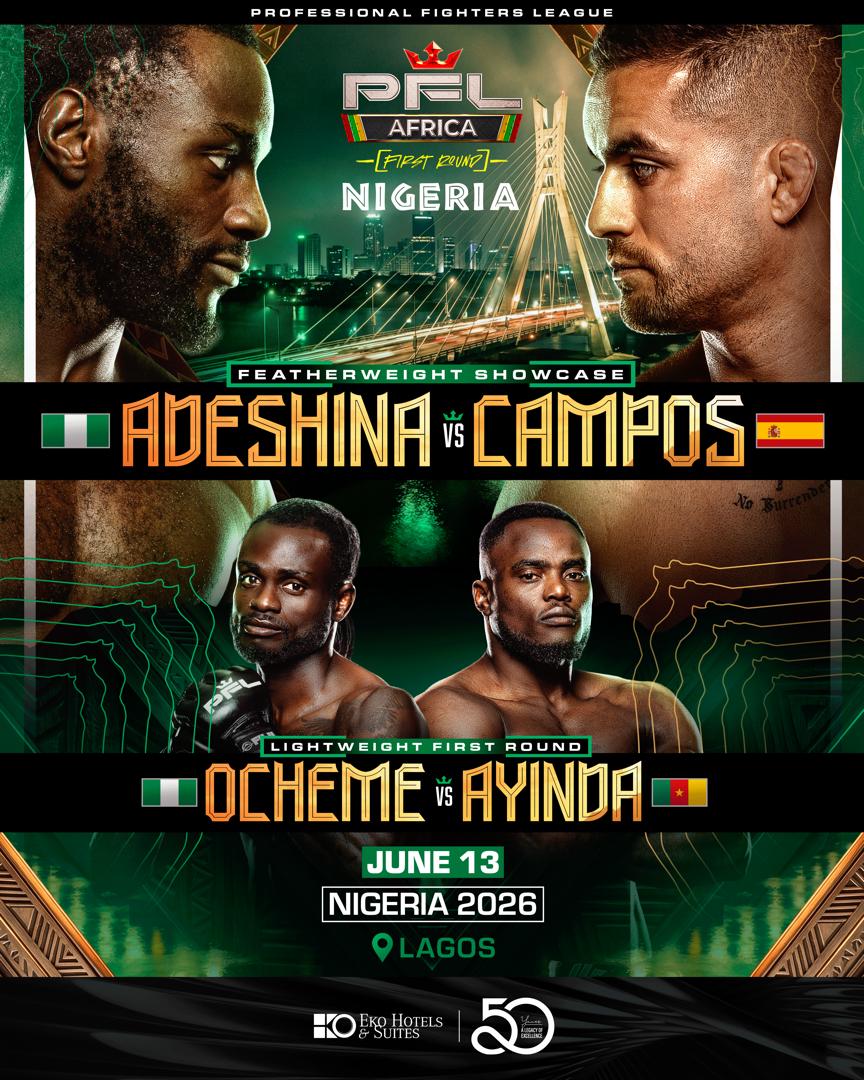
Nigeria’s Wasi Adeshina to Headline Historic Nigeria Event against Ignacio Campos
Patrick Ocheme Faces Octave Ayinda in Lightweight First Round Co-Main Event
The Professional Fighters League today announced the first pair of bouts as PFL Africa heads to Nigeria for the first time at the Eko Convention Center in Lagos on Saturday, June 13, 2026. The event will mark the largest MMA event in West African history, featuring the opening round of the PFL Africa bantamweight and lightweight tournaments, alongside showcase bouts highlighting top regional talent.
Headlining the event will be a featherweight Showcase Bout featuring Nigeria’s Wasi “The Nigerian Jaguar” Adeshina (10-3), who will compete in front of a home crowd in the main event against Spanish star Ignacio “Nacho” Campos (7-2). Adeshina enters as one of the notable local athletes on the card and will look to deliver a strong performance as PFL Africa lands in Nigeria for the first time. Campos, on the other hand, is coming off a big win over Mathys Duragrin at PFL Madrid last month.
The co-main event will feature a lightweight first round tournament bout between Nigeria’s Patrick “Star Boi” Ocheme (8-1) and Cameroon’s Octave “The Bantu Warrior” Ayinda (7-1). Ocheme will look to capitalize on the home advantage as he begins his tournament campaign, while Ayinda enters as a challenger aiming to secure a statement victory in the opening round.
“Making our West African debut in Lagos is a major milestone for PFL Africa, and one we’re incredibly excited about,” said Elias Schulze, General Manager of PFL Africa. “Nigeria brings incredible passion, culture, and talent, and Lagos is the perfect stage for this moment. The energy from the fans, the depth of local talent, and the opportunity to showcase it all on a global platform make this event truly special. We’re bringing elite competition to one of the most vibrant cities in the world, and highlighting the pride, colour, and intensity that define African MMA.”
Additional bouts for the PFL Africa: Nigeria – First Round card will be announced in the coming weeks.
PFL Africa: Nigeria – First Round card:
SuperSport (Africa – English) | Canal+ (Africa – French)
Saturday, June 13
Featherweight Showcase Main Event: Wasi Adeshina (10-3) vs. Ignacio Campos (7-2)
Lightweight Tournament First Round: Patrick Ocheme (7-1) vs. Octave Ayinda (8-1)
ABOUT PROFESSIONAL FIGHTERS LEAGUE
The Professional Fighters League (PFL) is a global mixed martial arts organization and one of the world’s leading combat sports properties. PFL produces live, premium MMA events broadcast and streamed to fans in more than 170 countries through an extensive network of international media partners. The organisation features a roster of professional fighters representing the highest levels of international mixed martial arts competition.
Headquartered in the United States, PFL holds events across North America, Europe, the Middle East, and Africa, with continued global expansion underway. PFL is backed by leading institutional investors and professional sports team owners, reflecting the accelerating growth of MMA as a mainstream global sport.
For more information, visit PFLmma.com and follow PFL at Facebook.com/PFLmma and @PFLMMA on X, Instagram, and TikTok.

Nigerian prophet, Primate Elijah Ayodele, who is the leader of INRI Evangelical Spiritual Church, has definitely grown his influence beyond the shores of his country; his prophetic influence has traveled round the whole of the African continent.
As he is known in Nigeria as a man of God who says a thing and it definitely comes to pass, so he is known in other countries as that foreign voice that reveals things to come; that lonely voice that prophesies a thing and it surely comes to pass.
His prophecies on the presidential elections in the Benin Republic and Djibouti have further proven that Primate Ayodele is a true man of God who doesn’t base his prophecies on hearsay or already established information but through the word of God.
For several years, Primate Ayodele has been talking about the presidential election in the Benin Republic, stating repeatedly that the opposition will be handicapped by the president in the country and that the president’s candidate would eventually emerge as the next leader of the country.
In one of his most recent prophecies about the election, Primate Ayodele made it known that the next president of the country would be the finance minister who was endorsed by the incumbent president to succeed him.
These were his words:
“The next president of Benin Republic is the present minister of finance.”
In fulfilment of the prophecy, Benin’s Minister of Finance Romuald Wadagni has secured a landslide victory in the country’s presidential election with more than 94 percent of the votes, according to provisional results.
Sacca Lafia, head of the country’s independent electoral commission, announced on national television late on Monday night that the result was based on more than 90 per cent of votes counted, highlighting Wadagni’s unassailable lead.
This isn’t the first time Primate Ayodele’s prophecy has had a great impact in Benin Republic. Months earlier, he had foretold an attempted coup against the president of the country, and this came to pass exactly as he had mentioned.
In the same vein, Primate Ayodele had said the president of Djibouti would be elected for a sixth term in the country.
“There is going to be an election in Djibouti, the incumbent president will win again”
In fulfilment of his prophecy, Djibouti’s President Ismail Omar Guelleh has won an election with 97.8% of the vote, keeping him at the helm of the strategically-placed Horn of Africa nation for a sixth term, preliminary official results show.
The 78-year-old’s sole challenger, Mohamed Farah Samatar got 2.19% of the vote, in a poll boycotted by most of the opposition.
In power for 27 years, Guelleh had promised to step down, but ran for re-election after the constitution was amended in November to remove the upper age limit of 75 for presidential candidates.


Fidelity Bank Advocates for Inmates’ welfare with donation to Enugu Custodial Centre

Africa Caught Off-guard as Idris Elba Stuns with FIFA World Cup Message

Building Systems that outlive Founders – Bidemi Oke
Regberegbe 1986, 87 and 88 Appoints Deputy Speaker As Adviser Okunrin

9mobile, Kantar Discuss Building Impactful Brands for the Future
dLocal Enables Payments from Verve Cards and Tokens for Global Merchants
-

 NEWS2 days ago
Governor Dauda Lawal Receives Nigerian Air Force Delegation in Gusau to Strengthen Security, Combat Terrorism
-

 Brand2 days ago
InterswitchSPAK National Science Competition: A Life-Changing Opportunity for Nigerian Students
-

 Banking and Finance2 days ago
Fidelity Bank Extends “Give Her Power” Initiative to Ogun State, Empowers 100 Women with Vocational Tools
-

 Brand2 days ago
One Universe Launches to Redefine How People Find and Pay for Trusted Services
-
 Cover14 hours ago
Building Systems that outlive Founders – Bidemi Oke
-
 NEWS14 hours ago
Africa Caught Off-guard as Idris Elba Stuns with FIFA World Cup Message
-
 Brand14 hours ago
Fidelity Bank Advocates for Inmates’ welfare with donation to Enugu Custodial Centre