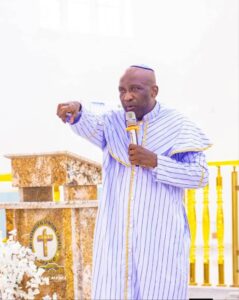
Artificial Scarcity Initiated By The Elites Will End If I’m Elected As The President – Adewole Adebayo

Prince Adewole Adebayo is the presidential candidate of the Social Democratic Party, SDP. He believes in the ideals of the SDP because, he says it has always been his party of choice as an MKO Abiola boy in the early 1990s
Whereas he said he tried to ensure a merger with another party, he would have loved to associate with, the Peoples Redemption Party, PRP, as also a follower of Mallam Aminu Kano, the move didn’t materialise.
He claims to be a social democrat because he cares about investing in people, adding that government resources must be spent on the left side of the divide: housing, education, health, food supply and infrastructure for the people; and build other things from there on. He insists that SDP aspires to be independent, and the party is in every ward of Nigeria, invoking the legacy of MKO Abiola.
His thoughts are radical and even when asked, as a way of indemnification, whether he would be willing, if called upon to substantiate his many weighty allegations of graft in high places, he gave this response:
“Is it not weighty or weightier that a sovereign country is losing billions of dollars and millions of crude oil barrels to thieves? What can be weightier than that? In Saudi Arabia, you will be shot for stealing one gallon. The President has people everywhere and he’s the minister of petroleum resources by choice, so he ought to know what is going on in that space”.
A lawyer, who has interests and investments in agriculture, pharmaceuticals and broadcasting, Prince Adebayo’s operations and philanthropy cut across many fields and almost all continents of the world.
Excerpts:
With what is going on in the country today, what strategies or ideas are you bringing to the table that you would want Nigerians to appreciate you for?
The idea any Commander-in-Chief must have is for the function of that office to be performed properly.
President Buhari would tell you he is performing the function very well. His people always say so?
With due respect, President Buhari is not performing anything! He has given you evidence why he’s not performing it.
One, he said he’s surprised that Kuje Prisons was attacked, even though there were said to be about 42 or 44 security reports hinting of a possible attack on that facility. He’s not following intelligence the way he should and he has constituted his security apparatus wrongly. He has brought in people based on nepotism, trying to compensate people. Many people who featured during his campaigns were bidding for the job of National Security Adviser, NSA. You’ve seen the way they’re jumping up and down about security architecture. But if you study the Terrorism Prevention Act, 2011, which is now 2022, you’ll notice that he has gotten it wrong from start.
The security agencies under me will not be fighting one another. The way they are doing their contracting has made Buhari’s security people to become joint stakeholders with Boko Haram, joint stakeholders with bandits, joint stakeholders with kidnappers and other criminals.
This is so because if the criminals make money, they, too, make money. And there are no consequences for failure. And there’s no reward for success. So, in that state of anomie that he has created, the essence of government has been defeated. We are now back to the opposite of what Thomas Hobbs recommended, that the government is supposed to come and prevent a situation where we are having survival of the fittest. So, life now is short, nasty and brutish.
What I will do is to select the very opposite of the people Buhari has selected. There are people out there who know exactly what to do.
I have more than 40 to 50 people that I know for sure, within 90 days, they will put an end to this insecurity. Then, there is no inter-service collaboration because there is too much competition such that one person’s failure is another person’s success and vice versa.
He’s lost control and there is disorder. Our armed forces have the capacity, fluidity, mobility and all the platforms that they can use, if properly led, to stem the tide.
We are talking about a disengaged four-star general of the Nigerian Army, who was also a military head of state; so if it was this easy, why do you think, without prejudice to all you have said, the shape-shifting nature of insecurity continues to, in my view, trounce the knowledge and competence of President Buhari?
First, I’m happy that you’ve referred to this but I do not think Boko Haram or bandits are impressed with the titles of President Buhari.
Let’s examine the records because part of the mistake we made was to assume that if you’re a General, you must know what you’re doing in terms of security. Wars are lost and won with generals on both sides, so, those who lose wars, is it that their side did not have generals? I have the utmost respect for the person of Buhari, but he has no tangible record of success that we can point to now because seven years is enough to prove what was learnt in the armed forces. He’s not aware of so many things.
When I already knew that our crude was being stolen, I’m not so sure he was aware even as Minister of Petroleum Resources. As we are talking now, they are stealing our crude off-shore and at our terminals. There are vessels out there waiting to steal our crude.
This issue of crude theft, how does it make you feel that a 3m-barrel vessel, Heroic Idun, came into Nigeria, stole crude oil and was only arrested by the security forces of Equatorial Guinea? We can say all we want, the President cannot be omnipresent and without holding a brief for him, how would you be able to deal with such?
As President and Commander-in-Chief, you’re supposed to be omnipresent. You are, because it is not only you; everywhere you have people, they act in your name. There’s nowhere in Nigeria that there’s no intelligence being gathered. If President Buhari wants to know where I am now, it may take him probably two to three minutes, he’ll know where I am. If he wants to bug this interview session, he has all the facilities, he can do it.
A former head of state told me that in the 1970s, that from Dodan Barracks, he could get whatever information he wanted in Nigeria and that there’s always a situation room in the presidential villa that if it is functional, you can be omnipresent. Every paraphenalia of support has been given to the President and all those soldiers saluting you are not there for fun. You have services, both domestic and international. You have humongous resources to find out. How did I get to know? I got to know in my preparation for the office of President and Commander-in-Chief and I started doing my research. That day that vessel was caught, it wasn’t the only one. As we speak, there are vessels still there and they have owners. They are insured and they are coming from somewhere. They have captains. And they are going to discharge the stolen crude somewhere.
Once this is published, would you be ready and willing to make disclosures to the government in the event that they call you, based on what you’re saying now and say they need your support?
How would they need my support? They are the ones stealing the crude. Don’t you understand my point? You’re telling me that the bank robber needs my support to know there is bank robbery.
That’s weighty and that’s why I’m saying Nigeria may need your help?
Is it not weighty or weightier that a sovereign country is losing billions of dollars and millions of crude oil barrels to thieves? What can be weightier than that? In Saudi Arabia, you will be shot for stealing one gallon. The President has people everywhere and he’s the minister of petroleum resources by choice, so, he ought to know what is going on in that space
If we tie this to the anti-corruption crusade which brought him to power, in your view, how would you access his strides so far in seven years?
He’s not on the ballot any more but the truth is that President Buhari does not hate corruption. He hates his enemies and uses anti-corruption to embarrass them. He came to power with the money of corrupt people – forms were bought, dresses were bought for him, he flew in their private jets and he’s compromising with them. There are thieves in his government and he knows them. He refused to fire them.
Since he’s not contesting against me, I wish him well in retirement and I don’t want to add to his problem but if anyone tells me Buhari hates corruption, yet he has people with cases of corruption around him, that person hates the truth.
Some see fiscal federalism as an Eldorado, a panacea of sorts that can solve Nigeria’s problem within the context of people getting their fair share. But some others believe and insist that the individual can make a difference if he means well and wants to do well? Which takes precedence?
Both! What we need to know in this country is that we can have structural problems and you can also have moral problems. Unfortunately for us, we have both.
This crude theft, for instance, is a combination of federal and state government. That’s why some state governors have become overlords and can silence you with millions of dollars in cash and that’s why they are funding politics and some don’t care. Why should an oil-producing state be borrowing money to pay salaries and the governor will not complain. Zero remittance from NNPC and the governor of an oil-producing state will not shout or go to court because some of them are involved in what is going on. Some governors are getting richer while their states are getting poorer and some people at the federal level are getting richer while the Nigerian state is getting poorer. Fiscal federalism is good and our administration can make it work. But if you have immoral people in charge, nothing will work.
What is killing Nigeria is that we think that we are cleverer than Almighty God, that we can be a bunch of liars and be praying on Sundays and Fridays but we don’t want to say the truth.
The Nigerian elite has formed a criminal alliance with international criminal gangs and they are inviting them to Nigeria to steal gold in Zamfara and Osun States and kill people and steal crude from the oil-producing states and come as fake investors and take money away in bogus contracts. How can fiscal federalism stop that? If you say people should control their resources and those in charge are thieves, the resources will be controlled for their benefit and the benefit of their friends alone. The elites are the problem. That is why we say Nigerians must wake up and vote right.
These elites have abandoned the people of Nigeria but the people of Nigeria should not abandon themselves – they should vote right. Nobody should say there’s a government looking after your interest. That’s why I’m wondering how this wicked generation expects the blessings of God to come. Nigerians should stop fooling themselves. The elites are all and the same in the main political parties.
What is your agenda for Nigeria? Why do you want to serve? Let’s look at the areas of health, education, and infrastructure. What will you be telling Nigerians because when you say this government has borrowed too much money, they tell you it is for infrastructure. In the first quarter of this year, we made N1.6trillion or so but we spent N1.9trillion servicing debt?
The rule of law is important. I want to serve Nigeria. The first thing to do is to tell Nigerians where their money is – from crude, gas, taxation. When you know where your money is, people will be at peace. We will be exact about our earnings. I will dispel all the lies being told today. Ask anyone on the board of NNPC, ask how much Nigeria has made from gas or crude? They will not know. How much crude flows from Qua Iboe terminal, from Forcados or from Escravos, they cannot give you the exact figures.
Have you asked them and they claimed not to know?
I’ve asked people in the Senate Committee on Appropriation, but they don’t know because they, too, have tried to find out. (Why do you think the committees of the Senate and House of Representatives keep inviting these people and sometimes, they refuse to appear and even when they appear, the figures are always contradicting one another.
A commissioner in any of the states is entitled to adequate data on our income as part owners of Federation Account. We are supposed to know what we are earning. States and LGs are entitled to know what Nigeria earns as part of the government. How many governors know the flow of oil Nigeria extracts or sells? So, how can you know you’re broke if you do not know how much your salary is or how much you earn?
The first thing would be to put responsible people in government, people who are going to be clearly accountable. The way our system works, CBN is supposed to have an independent system to verify what is going on, so also is the ministry of finance. The Revenue Mobilisation and Fiscal Commission, RMFC, is supposed to have its own independent verification system too; so also the Auditor-General and Accountant General of the Federation; NNPC, Minister, DSS, Police are supposed to know, Navy is supposed to know.
All these sectors are supposed to know. If you go to Lloyds of London, they will tell you how much crude is taken out of Nigeria from time to time because the balance of a ship is digitally monitored, the tonnage is insured, the pilotage is recorded. But I don’t want to give too much away. We will get you every ounce of your crude back, the way we are recovering Abacha money now, that’s how I will recover crude stolen under Buhari for you.
Education/Health
When you have recovered your stolen money or when you have an idea of your earnings, you can then budget and finance the budget effectively.
The minister of works, Fashola, was very brilliant and smart; but he said he couldn’t do Lagos/Sango Otta road, Lagos/Badagry road because he gave illustration that in one of the projects, he needed N50b to do the roads but he was given N200m. That’s just about how much two people will pay for APC’s presidential form.
And those two people are ministers inside the same government, but he, as minister of works, for a N50b road, was given N200m, and in some others, no money was allocated. In one instance, he went to Sukkuk to borrow N7b. Even at that, N7b for a N50b road, that in itself, is a joke. We just see ‘Men At work’ but no work.
Then they’ll tell you the road will soon be completed. Now, that same government that says there’s no money for Fashola to do Sango Otta road or the Badagry road which is our gateway to ECOWAS countries – our natural trading partners – that same government’s Accountant General is alleged to have stolen N109b. So, you can see the paradox: They are so tight, no money to do the roads but an Accountant General is alleged to have made away with N109b because they have been so loose.
If we can account for the funds, we can deal with the sectoral issues. They know where the funds are. I know where the funds are.
They are just being wicked. The N11 Trillion that they say they want to borrow, go and pick a copy of Ahmed Joda Report, you’ll see where the N11trillion came out from. They are just playing poker with us. The way they have shared the money, when we come in, it won’t be so. We will recover our money.
When I started shouting about crude theft five months ago, people thought I was mentally deranged. After a month, they came out and said I was exaggerating.
Just a few days ago, the Chief of Naval Staff said I was exaggerating, that some of the losses are not only theft but other losses. I can’t understand why somebody will be helping the thieves to explain where the losses are from. So, they know people are stealing the crude. Look at the way they shared dollars during their conventions. They are the same people speculating with the dollars and creating the scarcity you see.
There’s money to fix healthcare, education and infrastructure. I won’t give too much away now but at the end of the day, it is about prioritising areas of urgent intervention and effectively utilising resources.
Ethnic tension
The answer is justice. There’s so much injustice in the land. When they want to steal crude, Yoruba, Igbo, Ijaw, Hausa, Junkun, Fulani, they all conspire to steal the crude.
When they want to defraud the government and steal N109b, they work together; when they want to steal arms money, they all collaborate. Don’t you see them when they take them to EFCC? Do you see any bias in the stolen funds? What the Nigerian elite has done is that they have created artificial scarcity. Because they have stolen so much, what they’ve now done is to create competition for the crumbs.
So, instead of building FGCs in every federal constituency and having 360 of such – because our population is increasing – they keep the same old FGCs so that all the tribes will be competing against each other such that the one that scores more may not be given admission.
Instead of funding the universities adequately and expanding them to accommodate the hundreds of thousands writing JAMB that will pass, they now create catchment nonsense and state of origin as a basis to give admission. These things create tension.
Instead of providing jobs for all, they’ll use nepotism as a basis for employment and these things create tension. If you have a country that has justice, where the leaders are not stealing the money, where adequate provision is made for the masses, and you give admission to somebody who merits it, that person will not bother to find out if the VC is from his state or not. Ethnic tension is being created by the political leaders to divert attention and distract the people.
Even the historical areas where you can say there are issues, these things can easily be worked out. The problem now is that your ethnicity determines whether you’ll eat well or not. Your religion determines whether you get a promotion or not, whether you get a job or not.
This ethnicity thing has become a major issue. Right now as I talk to you, in Nigeria, there’s no fight between short people and tall people, between fair-skinned and dark-skinned or fat and lean people. But if you start using these parameters to allocate jobs, houses or admission, you’ll start hearing that short people are killing tall people and fair-skinned people are poisoning dark-skinned people.
Any identity that you use for any competition, or to manage scarcity will create tension. That is why you have not heard Igbos say it is their turn to inhale oxygen because it is abundant. But if it was scarce and we were rationing oxygen through canisters, there would be serious wahala. That was why Awolowo said ‘I will give you life more abundant’. That was also why Fela asked, ‘water, light, house food, wetin do dem?’
That is why in Chapter Two of our Constitution, we have Fundamental Objectives and Directive Principle of State Policy. We envisaged these things and many of those radicals of those days insisted that we should put this Fundamental Objectives and Directive Principle of State Policy in our constitution but they removed and said it should not be justiceable because people do not want justice.
That same Chapter Two, how we should budget, spend the money and how to take care of our people, they are spelt out there. This is a great republic and it shall be great.
About The Author