
Business
FBN Holdings Plc Announces New Board Appointments


FBN Holdings PLC (“FBNHoldings), Nigeria’s leading financial holdings company, has announced the appointments of Mr. Seni Adetu and Mrs. Juliet Anammah as Independent Non-Executive directors, while Mr. Otu Hughes has been appointed as a Non-Executive director. These appointments are subject to the approval of the Central Bank of Nigeria (“CBN”).
Speaking on the appointments, the Group Chairman of FBN Holdings Plc, Dr. Oba Otudeko, CFR, said, “On behalf of the board, management and staff of FBNHoldings, I am delighted to welcome the trio of Seni Adetu, Mrs. Juliet Anammah and Otu Hughes to the FBNHoldings board as they bring on board their combined professional experience and expertise of over 97 years, cutting across various industries and institutions of global repute.”
“I am certain that these rich experiences will have immediate and long-term impact on the group and its subsidiaries across Africa and beyond,” he added further.
SENI ADETU
Seni Adetu, a former Managing Director/CEO Guinness Nigeria Plc, has 35 years of private sector experience garnered at the highest levels primarily with John Holt Plc, Coca-Cola International and Diageo (Guinness) Plc in various countries within and outside Africa. He holds a first degree in Chemical Engineering and Masters in Business Administration (with specialization in Marketing), both from the University of Lagos. Adetu was at various times Marketing Director, Coca-Cola Nigeria Ltd, Managing Director of Coca-Cola, and the first African Managing Director/CEO and Executive Vice Chairman of Guinness Ghana Plc.
In 2009, Adetu was appointed Group Managing Director/CEO East African Breweries (EABL), the biggest company in East Africa, based in Kenya, during which time he was named Runner-up Forbes/CNBC CEO of the Year 2012 in East Africa. He was subsequently appointed MD/CEO of Guinness Nigeria Plc and Executive Chairman Diageo Brands Nigeria thus, again becoming the first Nigerian in nearly 20 years to lead that company. Adetu has had working stints in Hungary and the UK and has been exposed to various high-profile leadership courses globally including at the prestigious Harvard Business School.
He has served on the boards of various multinational companies in both Executive and Non-Executive capacity in Nigeria and abroad and was until recently an Independent Non-Executive Director on the Board of Fidelity Bank Plc and Non-Executive Director at APT Pensions Ltd among others.
Adetu is the Founder/Group CEO of Algorithm Media Limited and Ogilvy Nigeria Limited, two leading Marketing Communications agencies in Nigeria, in partnership with WPP, the world’s largest advertising and media agency network. He is a member of many reputable social clubs including the Metropolitan Club Lagos. He is also the immediate past National Vice President of the University of Lagos Alumni Association.
JULIET ANAMMAH
Juliet Anammah is Chairwoman Jumia Nigeria & Head of Institutional Affairs Jumia Group. Jumia is the largest eCommerce platform in Africa and the first African Tech start-up to be listed on the NYSE
She is an experienced executive with 28+ years of professional experience including 7 + years at Partner / Chief Executive level.
Before her current role, she was the CEO of Jumia Nigeria. Prior to joining Jumia, Juliet spent 16 years at Accenture and was the Partner managing Accenture’s Consumer Goods Practice in West Africa.
A Pharmacist by training, she started her career in Sales & Marketing with May and Baker (Sanofi-Aventis) in 1991 before joining Accenture as a Senior Strategy Consultant in 1999.
Juliet also serves on Corporate and non-profit Boards in a non-executive capacity. She is currently on the Boards of Flour Mills of Nigeria and APT Pensions as Independent non-executive member. She is also an EXCO member of Consultative Action Group for the Poor (CGAP) a not for profit agency funded by the World Bank, Bill and Melinda Gates Foundation and several Bilaterial/ Multilateral agencies.
She holds a Bachelor of Pharmacy degree, an MBA (Finance track) and is an alumnus of both Wharton College University of Pennsylvania (AMP) and Yale University.
OTU HUGHES
Otu Hughes has over 25 years’ experience in operations and strategy, principal investment, mergers and acquisition as well as capital raising in both the US and Sub-Saharan Africa. He started his career in 1993 with Lehman Brothers, providing strategic and financial advisory services to government entities and companies in privatisation and empowerment issues, notably Brazil (power and mining), Ghana (mining), South Africa (empowerment programmes), amongst others.
Otu joined Deutsche Bank in 1998 as Associate– Mergers, Acquisitions and Corporate Advisory Group with the oversight responsibilities of providing mergers, acquisitions, corporate and strategic financial advisory services to companies and government agencies across industries and countries, rising to Vice President. He is the Co-founder and Principal of Rofgam/Hughes Consulting and also worked at KeyBanc Capital Markets, amongst many others.
Otu is the Co-Founder & Managing Director of Candesco Limited, set up with the primary responsibility of developing and managing off-grid and independent power projects for Sub-Sahara Africa market, providing affordable, clean and stable power to clusters of communities.
Business
FIRSTCAP CLOSES N4.46BN LAPO MFB SPV PLC SERIES 1 BOND, DEEPENS ACCESS TO LONG TERM CAPITAL
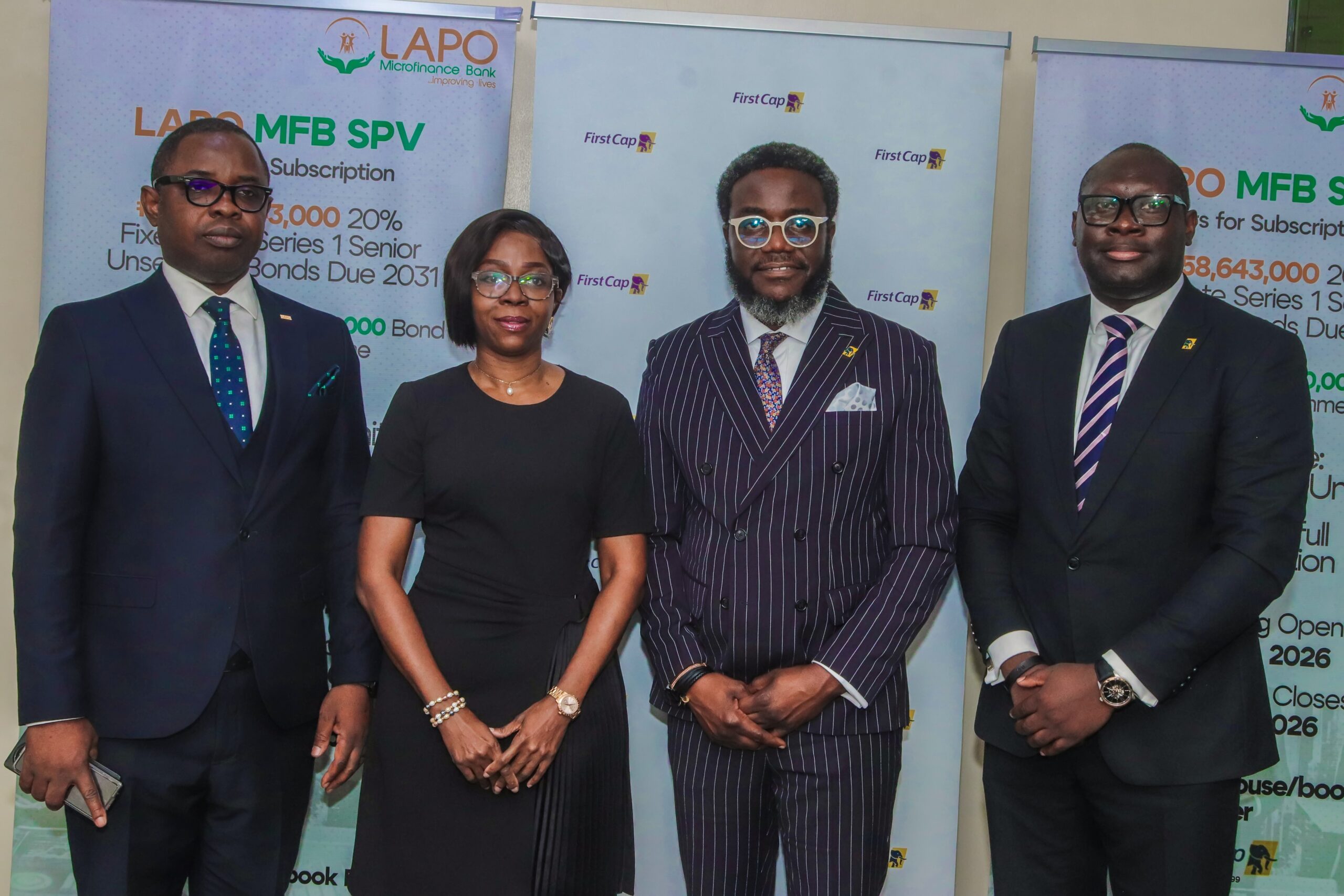
IMG_5294 L-R: Chief Finance Officer, LAPO Microfinance Bank, Emmanuel Igiehon; Managing Director, LAPO Microfinance Bank, Cynthia Ikponmwosa; Managing Director, FirstCap Limited, Ukandu E. Ukandu, and Head of Capital Markets, FirstCap Limited, Oluseun Olatidoye, at the LAPO MFB SPV Plc Series 1 Bond Issuance Signing Ceremony recently held in Lagos.
Lagos, Nigeria – April 2026 — FirstCap Limited, a leading investment banking firm and subsidiary of FirstHoldCo Plc., has successfully closed the ₦4.46 billion Series 1 Bond Issuance by LAPO MFB SPV Plc, reinforcing its strong leadership in Nigeria’s debt capital markets and deepening access to long term funding for high impact sectors.Acting as Lead Issuing House, FirstCap structured the fund raising on behalf of LAPO MFB SPV Plc (a company sponsored by LAPO Microfinance Bank Limited to mobilise institutional capital targeted at SME financing, renewable energy expansion, and digital financial services, three critical drivers of inclusive and sustainable economic growth in Nigeria.The transaction is underpinned by a compelling impact thesis, with proceeds strategically deployed to support small businesses and clean energy initiatives. The microfinance sector continues to demonstrate resilience and strong fundamentals positioning the issuance at the intersection of growth, sustainability, and financial inclusion.Commenting on the transaction, Ukandu E. Ukandu, Managing Director, FirstCap Limited, said:
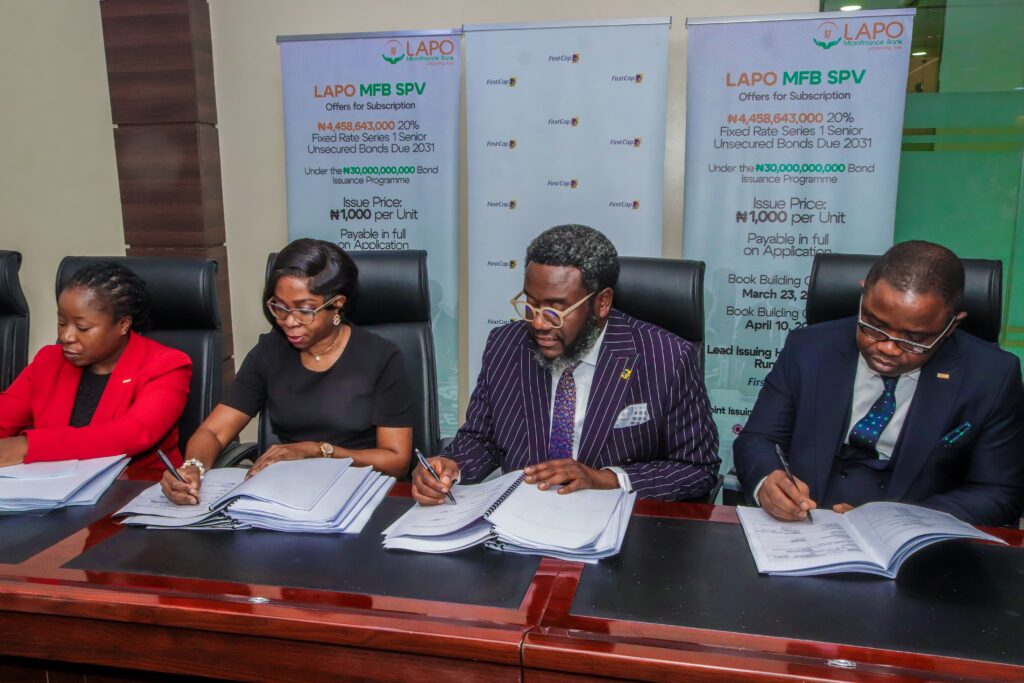
L- R: Company Secretary, LAPO Microfinance Bank, Peggy Idehoy; Managing Director, LAPO Microfinance Bank, Cynthia Ikponmwosa; Managing Director, FirstCap Limited, Ukandu E. Ukandu; Chief Finance Officer, LAPO Microfinance Bank, Emmanuel Igiehon, at the LAPO MFB SPV Plc Series 1 Bond Issuance Signing Ceremony recently held in Lagos.
“This successful issuance underscores our strategic commitment to directing capital where it delivers measurable economic impact. At FirstCap, we partner with institutions that have the scale, discipline, and vision to transform markets, and LAPO exemplifies these qualities.The ₦4.46 billion bond is positioned to be a catalyst for SME growth, expanded energy access, and broader financial inclusion. We remain committed to structuring transactions that are not only bankable, but impactful and aligned with Nigeria’s long term economic trajectory.”FirstCap Limited remains committed to leading from the forefront of Nigeria’s capital markets, structuring transactions that are bankable, impactful, and investable, while supporting the future trajectory of Nigeria’s economic development.”
Across Africa, cryptocurrency has evolved from a fringe experiment into a serious financial instrument. From remittances and cross-border trade to inflation hedging and digital savings, millions of Africans now interact with crypto not as speculation, but as utility. Yet while the market is maturing, many African crypto brands are still communicating like Silicon Valley startups, fast, flashy, informal, and overly obsessed with hype. That approach may have worked in the era of early adoption. It will not sustain trust in the era of mainstream finance.The future belongs to crypto brands that communicate like banks.This does not mean becoming boring, bureaucratic, or detached. It means understanding that financial services are built on trust, clarity, consistency, and accountability. Customers can forgive a fashion brand for vague messaging. They cannot forgive a financial platform for uncertainty.Across the continent, trust remains one of the biggest barriers to financial innovation. Consumers have witnessed collapsed schemes, frozen wallets, rug pulls, and overnight disappearances disguised as “investment opportunities.” Many people do not distinguish between legitimate blockchain businesses and opportunistic fraudsters. To the average customer, they often look the same: sleek logos, social media promises, referral bonuses, and aggressive influencer marketing.That is where communication becomes strategic.Banks spend decades refining the language of confidence. They explain risk. They publish policies. They reassure customers during uncertainty. They understand that silence during a crisis can trigger panic. Crypto brands operating in Africa must adopt the same discipline.When customers ask where their funds are stored, how transactions are processed, what happens during delays, or how disputes are resolved, the answers should not be buried in jargon-filled FAQs. They should be visible, simple, and repeated consistently across channels.In practical terms, this means moving away from the startup culture of “move fast and explain later.” Financial trust does not work that way. If a platform experiences downtime, users should hear from the company immediately. If regulations change, brands should educate users calmly and clearly. If there are risks, they should be disclosed honestly, not hidden beneath marketing slogans.African regulators are also paying closer attention to the digital asset sector. From the Central Bank of Nigeria to the Securities and Exchange Commission, institutions increasingly want visibility, compliance, and consumer protection. This should not be seen as hostility. It is a signal that crypto is entering the serious room of finance.And in serious rooms, communication standards matter.The brands that will thrive are not necessarily the loudest on social media. They will be the most credible. They will issue timely updates, publish transparent policies, train customer-facing teams, respond professionally to complaints, and speak with the calm authority expected of custodians of value.Take remittances as an example. Many Africans use crypto rails because traditional transfers can be expensive or slow. But if a user sending school fees from United Kingdom to Nigeria encounters a delay, speed is no longer the only concern. Assurance becomes everything. A prompt explanation can retain a customer. Silence can lose them forever.This is where African crypto brands have a strategic advantage. They understand local realities better than many global competitors. They know the pain of currency volatility, settlement delays, and fragmented payment systems. But local relevance alone is not enough. They must pair innovation with institutional-grade communication.At FlashChange, for instance, the broader lesson is clear: in a trust-sensitive market, users do not only buy rates or speed. They buy confidence. Every message, update, customer response, and public statement contributes to that confidence.The next growth phase of crypto in Africa will not be won solely by technology stacks, token listings, or referral campaigns. It will be won by reputation.Banks learned long ago that money moves where trust lives. Crypto brands on the continent must learn the same lesson, and fast.Because if you are handling people’s value, their savings, or their transfers, you are no longer just a startup. You are a financial institution in the public mind. Communicate accordingly.John Kokome is the Corporate Communications Manager at FlashChange, a fintech platform redefining secure digital asset exchange. With experience across fintech, cryptocurrency, telecoms, and development communications in Africa. He currently leads strategic storytelling, reputation management, and stakeholder engagement initiatives at the company, focusing on building trust, transparency, and financial literacy in the digital assets space. John’s work sits at the intersection of policy, technology, and public perception, with a strong emphasis on Africa-first narratives and responsible innovation. He has contributed opinion pieces and thought leadership articles on governance, youth empowerment, branding, and Nigeria’s evolving digital economy.
Business
Sterling Bank, One Foundation, Sunbeth, Partners Strengthen Climate Action With Nationwide Cleanup, Beach Adoption
In a bold move to strengthen environmental protection across Nigeria, Sterling Bank, in collaboration with Sterling One Foundation, Lagos Waste Management Authority, Sunbeth, community volunteers, and partner organizations, are set to launch The Great Nigeria Cleanup, a nationwide environmental movement taking place on April 25, 2026.Spanning all six geopolitical zones, and aligned with the United Nations Decade ofAction, this initiative will mobilize citizens across Lagos, Abuja, Ogun, Osun, Cross River, Delta, Bayelsa, Ebonyi, Abia, Enugu, Imo, Sokoto, Kano, Benue, Plateau, Kogi, and Katsina, reinforcing the urgency of sustained, community-led efforts to combat plastic and waste pollution and restore the health of Nigeria’s environment.Speaking on the initiative, Temitayo Adegoke, Chief Operating Officer of SterlingBank stated: “At Sterling, we believe that real impact happens when institutions and individuals come together with a shared purpose. The Great Nigeria Cleanup is our collective opportunity to not only clean our surroundings but to redefine how we care for our environment. This is about building a culture of responsibility and pridethat will outlive this moment.” Also commenting, Olapeju Ibekwe, CEO of Sterling One Foundation added: “Thefuture we want for Nigeria depends on the actions we take today. The Great NigeriaCleanup is about more than sanitation, it is about dignity, wellbeing, and shared responsibility.We are proud to be part of a movement that empowers people acrossthe country to take ownership of their environment.”As Nigeria continues to face growing environmental challenges, including wastemanagement and urban pollution, The Great Nigeria Cleanup stands as a timelyand urgent response, one that brings together government, private sector, andcitizens to drive meaningful, lasting change.
On April 25, Nigerians everywhere are encouraged to step out, show up, and be part of this historic movement. Because a cleaner Nigeria is not just a vision, it is a responsibility we all share. //Ends.About Sterling Bank LimitedSterling Bank is a full-service national commercial bank in Nigeria and a member ofSterling Financial Holdings Group. With a heritage of more than 60 years, the bankhas evolved from Nigeria’s pre-eminent investment banking institution to a trusted provider of retail, commercial, and corporate banking services.Sterling is a forward-thinking financial institution committed to transforming lives through innovative solutions, exceptional service, unwavering integrity, and a steadfast focus on its HEART strategy, which centers on Health, Education,Agriculture, Renewable Energy, and Transportation. As pioneers in digital banking and financial inclusion, Sterling continues to lead by example, showing how purpose-driven leadership can deliver transformative outcomes for individuals,businesses, and society at large.Guided by a culture of innovation and a passion for excellence, Sterling Bankremains dedicated to redefining the banking experience for millions of customers across Nigeria. For more information visit https://sterling.ng/About Sterling One Foundation (SOF) is a registered non-profit focused on tackling the root causes of poverty in Nigeria, and Africa through interventions and social impact programmes across three critical sectors namely: health, education and climate action & food security. Gender Equality and women empowerment are integrated as a cross-cutting priority across all our programming areas. The Foundation’s programmes adopt a central theme of prioritizing partnerships for the achievement of the Sustainable Development Goals (SDGs). For more information visit onefoundation.ng.


2027: Lagosians Unite For Tinubu As Lawmaker Declares Bid

Ward Tour: Akeweje Flags Off Cash Support for Widows, Older People in Oro Ward 2

Fidelity Bank Provides Critical Funding Support to Abuja Special Needs Orphanage
Regberegbe 1986, 87 and 88 Appoints Deputy Speaker As Adviser Okunrin

9mobile, Kantar Discuss Building Impactful Brands for the Future
dLocal Enables Payments from Verve Cards and Tokens for Global Merchants
-
 Banking and Finance2 days ago
Unity Bank Disburses Over N500 Million Through Shocof To Support Traders
-
 Banking and Finance2 days ago
Fidelity Bank Provides Critical Funding Support to Abuja Special Needs Orphanage
-

 Sports2 days ago
El Clásico Tops European Football Weekend Action on SuperSport
-
 Politics2 days ago
Ward Tour: Akeweje Flags Off Cash Support for Widows, Older People in Oro Ward 2
-
 Politics3 hours ago
2027: Lagosians Unite For Tinubu As Lawmaker Declares Bid