Connect with us

Banking and Finance

Fidelity Bank’s GAIM 6 Promo Extension: A Timely Boost for Financial Inclusion and Economic Empowerment
Published

on

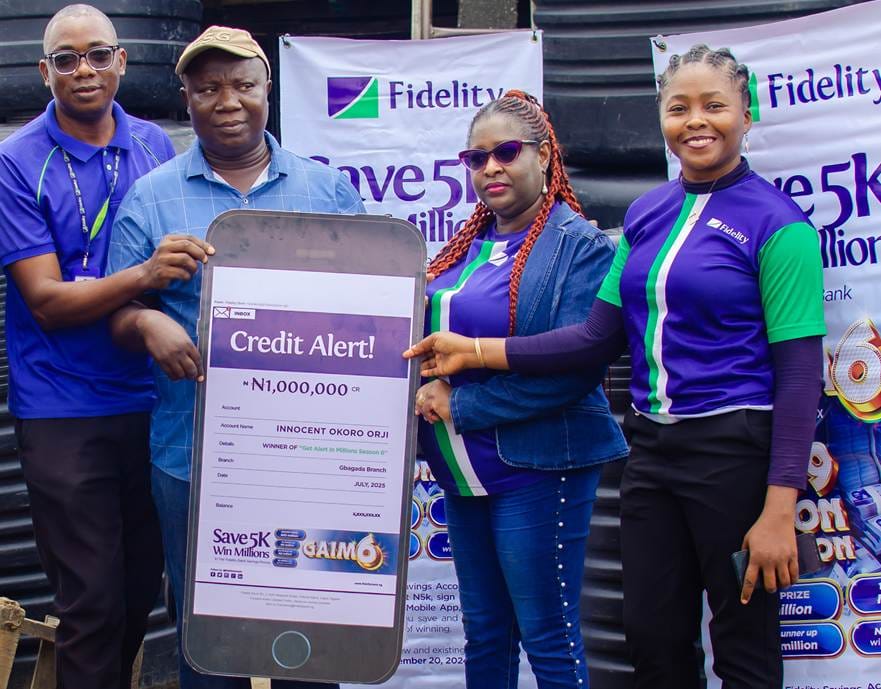
L – R: Direct Sales Executive, Fidelity Bank Plc, Adegboyega Ademokunwa; GAIM 6 Eight Monthly draw Winner, Innocent Okoro Orji; Branch Leader, Fidelity Bank Plc, Gbagada, Chinwe Umez-Eronini; and Product Manager, Savings, Fidelity Bank Plc, at the GAIM 6 prize presentation ceremony held at Gbagada Building Materials market in Lagos recently.

As Nigeria looks to opening up the economy and empowering its citizens, Fidelity Bank Plc has taken a bold step to deepen financial inclusion and reward customer loyalty by extending its flagship savings campaign, the Get Alert in Millions (GAIM) Season 6 promo. The extension adds three more months to the campaign and raises the total prize pool from ₦159 million to a record ₦189 million. This move, announced in September 2025, comes at a critical time when the country’s economic landscape demands innovative financial solutions and inclusive banking strategies.

The Nigerian Economy and the Imperative of Financial Inclusion

Nigeria’s economy, while resilient, faces persistent challenges including inflation, currency volatility, and limited access to formal financial services. According to the Central Bank of Nigeria (CBN), recent reforms such as exchange rate unification and bank recapitalization are aimed at stabilizing the macroeconomic environment and positioning the banking sector to support a $1 trillion economy. The CBN’s Payment System Vision 2028 also underscores the importance of digital transformation and financial inclusion as tools for economic development.

In this context, Fidelity Bank’s GAIM 6 promo is more than a marketing campaign, it is a strategic intervention that aligns with national goals. By incentivizing savings and expanding access to banking services, the promo contributes to the broader mission of empowering underserved communities and fostering economic resilience.

World Savings Day 2025: A Global Call to Action

The extension of GAIM 6 coincides with the upcoming World Savings Day on October 31, 2025. Celebrated annually, this global observance promotes the importance of saving as a pathway to financial security and economic stability. Fidelity Bank’s decision to extend GAIM 6 during this period amplifies the theme of the 2025 World Savings Day – “This is not a savings account”, encouraging Nigerians to cultivate smart financial habits and leverage digital banking platforms for long-term growth.

Speaking to journalists, Osita Ede, Divisional Head of Product Development at Fidelity Bank, emphasized the bank’s commitment to listening to its customers. “They asked for more opportunities to benefit from the promo, and we listened. With management and regulatory consent, we’re thrilled to keep the excitement going for another three months,” Ede said.

GAIM 6 vs. Other Savings Promos: What Sets It Apart

While several Nigerian banks run savings promotions, GAIM 6 distinguishes itself through its scale, inclusivity, and strategic design. The campaign targets a wide demographic, including NYSC corps members, women, children, and market clusters—segments often excluded from formal banking. Winners are selected through electronic draws supervised by the Federal Competition and Consumer Protection Commission (FCCPC), ensuring transparency and fairness.

Unlike promos that focus solely on high-value deposits, GAIM 6 allows participation with deposits as low as ₦2,000. This democratizes access and encourages participation from low-income earners. Moreover, the campaign integrates financial advisory support through the Fidelity SME Hub, helping winners make informed decisions about their rewards.

How GAIM 6 Works

GAIM 6 is designed to be simple, accessible, and rewarding. Customers can participate by opening a Fidelity Savings Account via the bank’s mobile app, website, USSD (77001#), or at any branch. Each ₦5,000 deposit earns an entry ticket into the monthly and grand draws. The final draw will award ₦2 million to the second runner-up, ₦5 million to the first runner-up, and ₦10 million to the grand prize winner.

The campaign also includes targeted draws aligned with national events such as Workers’ Day, Children’s Day, and Independence Day. These draws are complemented by regional activations, campus storms, and market outreach programs that drive engagement and account openings.

A Millionaire Christmas: Transforming Lives Through GAIM 6

With over ₦47 million still available in upcoming draws – ₦30 million in monthly draws and ₦17 million in the grand draw, Fidelity Bank is poised to create a wave of new millionaires just in time for the festive season. In the 7th and 8th monthly draws alone, 20 customers received ₦1 million each. These life-changing rewards not only boost individual financial security but also stimulate local economies through increased spending and investment.

“We are delighted to welcome our newest beneficiaries and commend their loyalty. A million Naira is a life-changing amount, and we encourage them to make the most of it,” Ede noted.

The bank’s financial advisory services at the SME Hub further enhance the impact of these rewards, guiding recipients on how to grow their winnings through smart investments and business development.

A Strategic Win for Fidelity Bank and Nigeria

The extension of GAIM 6 is a testament to Fidelity Bank’s responsiveness, innovation, and commitment to customer-centric banking. By aligning the promo with national economic goals and global observances like World Savings Day, the bank reinforces its role as a catalyst for financial empowerment.

As the campaign enters its final phase, Nigerians have a unique opportunity to save, win, and transform their financial futures by simply inculcating a healthy savings habit.

Continue Reading
Click to comment

Leave a Reply

Your email address will not be published. Required fields are marked *

Banking and Finance

Stewardship, Not Seizure: What the Union Bank Case Is Really About

Published

on

By

There is a particular genre of financial commentary that mistakes legal process fora factual verdict. A court delivers a first-instance ruling, procedural questions areraised, and before the ink is dry on the appeal filing, the narrative has alreadyhardened: the regulator overreached, investor confidence is shattered, andNigeria’s financial governance is on trial before the world. Much of thecommentary currently circulating about Union Bank of Nigeria belongs to thatgenre. It is not without merit on certain procedural questions. But it is, at its core,incomplete — and incompleteness in financial journalism carries costs that runwell beyond the column.The Acquisition That Started EverythingIn 2022, Titan Trust Bank Limited, then chaired by Mr Tunde Lemo, acquiredapproximately 94 per cent of Union Bank of Nigeria through two Dubai-registeredentities: Luxis International DMCC, promoted by Mr Rahul Savara, and MrCornelius Vink’s Magna International DMCC, both linked to the Tropical GeneralInvestments (TGI) Group. The US$300 million transaction was financedpredominantly through an Afreximbank facility. The CBN’s policy is unambiguous:borrowed funds may not be used to acquire shares in a licensed financialinstitution. That principle exists because debt-funded acquisitions hollow out thevery capital base they purport to build.That is precisely what happened. A forensic audit found that the Afreximbank loanwas ultimately reflected in Union Bank’s own books, with no hedgingarrangements against naira depreciation. As the currency weakened, revaluationlosses intensified, the capital adequacy ratio deteriorated into negative territory,non-performing loan exposure increased significantly, and a substantial capitalshortfall emerged. Critically, as stated in the Bank’s own Notice of Appeal, aspecial examination was conducted, and its findings were formally presented toformer Managing Director Mudassir Amray and the board then chaired by FaroukGumel, who were confronted with the institution’s grave financial condition andcontinuing regulatory infractions. The claim that the CBN acted without evidencebefore dissolving the board is, on the record, simply not accurate.The Legal PictureThe CBN acted under Section 34 of BOFIA 2020 and Section 52 of the CBN Act2007 — broad discretionary executive powers that do not require a specialexamination as a condition precedent. The Federal High Court’s characterisationof those powers as quasi-judicial is itself among the central questions now onappeal. Both the CBN and Union Bank have filed formal appeals. Union Bank’sown Notice of Appeal, filed the day after judgment on thirteen grounds and arguedby Olaniwun Ajayi LP, challenges the ruling on several fronts: that therespondents may never have had locus standi to sue in the first place, under therule in Foss v. Harbottle; that the application was filed nearly two years after theJanuary 2024 events, well outside the prescribed three-month limitation window;and that the CBN-supervised recapitalisation exercise, mandated under Section 9of BOFIA, cannot constitute evidence of bad faith. These are not technicalities.They are substantive questions of law that the Court of Appeal must nowdetermine. The Human Stakes and the Real QuestionBehind the legal arguments sit approximately 7.8 million depositors and around6,450 employees across 281 branches. Union Bank’s own affidavit describes it as asystemically important institution in a precarious financial situation, continuing torely on CBN forbearance for its existence — a frank admission that validates,rather than undermines, the case for intervention. Meanwhile, critics argue thedispute damages investor confidence. The wider evidence does not support thatconclusion. By April 2026, thirty-three Nigerian banks had raised N4.65 trillionunder the CBN’s recapitalisation framework — over ten times the 2004 to 2005consolidation figure. The Nigerian Exchange All-Share Index rose approximately29 per cent in the first quarter of 2026 alone. The market has read the CBN’sresolve as stability, not recklessness. Conflating this case with a systemicconfidence crisis runs the risk of misleading the very international investors thecommentary claims to be protecting.The structural vulnerability at the centre of this dispute originates not with theregulator but with an acquisition financed with borrowed funds, loaded onto theacquired institution’s balance sheet, and left unhedged against exchange-raterisk. When the CBN stepped in, it was doing what central banks everywhere areexpected to do. When Union Bank’s own legally constituted board subsequentlyfiled its own appeal, it was signalling what a properly constituted governancestructure recognises as being in the institution’s best interests. Nigeria’sappellate courts — not the court of commentary — are the appropriate arena forresolution.Union Bank of Nigeria is a 109-year-old institution serving nearly eight milliondepositors. It is not being dismantled. It is being stabilised under active regulatorysupervision, with operations intact and depositors protected. In the language ofinstitutional governance, that is called stewardship. The commentary thatmistakes it for anything else does the institution, its depositors, and Nigeria’sfinancial governance narrative a disservice that will outlast the headlines.*Bala Rabiu, writes from Kano

Continue Reading

Banking and Finance

Fidelity Bank Extends Food Bank Initiative to Thousands in Surulere

Published

on

By

Photo caption:L-R: Team Lead, Corporate Social Responsibility (CSR), Fidelity Bank Plc, Victoria Abuka; Personal Assistant to the President on Constituency Affairs, Hon. Khadijat Kareem Omotayo; Branch Leader, Adeola Odeku Branch, Fidelity Bank Plc, Ifeyinwa Asomugha; Surulere Local Government Executive, Anthonia Adenike Adjivon; and First Vice Chairman, Community Development Committee (CDC), Surulere Local Government, Adebayo Odukoya; during the Fidelity Food Bank outreach in Surulere, Lagos recently.

Leading financial institution, Fidelity Bank Plc, has reinforced its commitment to community welfare and sustainable development with the distribution of food packs to over 1,500 residents in Surulere, Lagos state.The outreach, executed under the Bank’s Fidelity Food Bank initiative, was carried out in partnership with the Office of the Personal Assistant to the President on Constituency Affairs and the Sodiq Abiodun Ogundare (SAO) Foundation.Speaking during the event, Regional Bank Head, Victoria Island/Lekki, Fidelity Bank Plc, Nnamdi Edekobi, represented by the Branch Leader, Adeola Odeku Branch, Fidelity Bank Plc, Ifeyinwa Asomugha, described the initiative as a reflection of Fidelity Bank’s unwavering dedication to improving the wellbeing of its host communities.“Today goes beyond the distribution of food items; it is about uplifting lives, creating opportunities, and strengthening our commitment to the wellbeing of families in this community.” he said.He disclosed that since inception, the initiative has distributed more than 150,000 food packs across Nigeria’s six geopolitical zones, positively impacting hundreds of communities nationwide. “Today’s outreach has provided over 1,500 beneficiaries with essential feeding supplies that will help address hunger, support healthy living, and improve the overall wellbeing of families. This initiative also aligns with the United Nations Sustainable Development Goal 2, which focuses on achieving Zero Hunger,” he added.Edekobi further commended the Personal Assistant to the President on Constituency Affairs, Hon. Khadijat Kareem Omotayo for supporting the initiative and fostering impactful partnerships that benefit underserved communities.Also speaking at the event, Hon. Khadijat Kareem Omotayo praised Fidelity Bank and the SAO Foundation for bringing meaningful support to residents of Surulere.“I am very happy that the foundation is growing. Fidelity Bank are our people and I appreciate this collaboration that has brought this massive opportunity to our people in Surulere Constituency 1,” she stated.She expressed optimism about sustaining future partnerships with the Bank to continue improving the lives and livelihoods of Nigerians.It would be recalled that the bank was recently recognized as the CSR Champion of the year at the 2025 Independent Newspaper Awards for its Food Bank initiative. The outreach to Surulere continues a legacy of impact, attracting community leaders, residents, and food bank partners, many of whom described the intervention as a timely boost amid prevailing economic challenges.Ranked among the best banks in Nigeria, Fidelity Bank Plc is a full-fledged Commercial Deposit Money Bank serving over 10 million customers through digital banking channels, its 255 business offices in Nigeria and United Kingdom subsidiary, FidBank UK Limited.The Bank is a recipient of multiple local and international Awards, including the 2024 Excellence in Digital Transformation & MSME Banking Award by BusinessDay Banks and Financial Institutions (BAFI) Awards; the 2024 Most Innovative Mobile Banking Application award for its Fidelity Mobile App by Global Business Outlook, and the 2024 Most Innovative Investment Banking Service Provider award by Global Brands Magazine. Additionally, the Bank was recognized as the Best Bank for SMEs in Nigeria by the Euromoney Awards for Excellence and as the Export Financing Bank of the Year by the BusinessDay Banks and Financial Institutions (BAFI) Awards.

Continue Reading

Banking and Finance

Sterling Financial Holdings Sustains Growth Momentum as Assets Cross ₦4 Trillion Mark in Q1, 2026

Published

on

By

…Group Profit rises 89% in FY2025, 53% in Q1 2026

Sterling Financial Holdings Company Plc (“Sterling Financial” or “theGroup”) has announced its audited financial results for the year ended December 31,2025, alongside its unaudited results for the first quarter ended March 31, 2026,delivering strong earnings growth, balance sheet expansion, and improved capitalstrength across the Group.According to statement by Group CFO, Sterling Financial Holdings Company PLC, Adebimpe Olambiwonnu, Gross Earnings for FY2025 increased by 44.4% to ₦486.8 billion, representing the strongest performance in the Group’s modern history. Profit Before Tax rose by 89.2% to ₦86.8 billion, while Profit After Tax increased by 74.8% to ₦76.3 billion.The Group’s balance sheet also strengthened significantly during the year. Total Assets reached ₦3.91 trillion, Customer Deposits grew to ₦2.98 trillion, and Loans and Advances closed at ₦1.41 trillion while Shareholders’ Funds expanded by 40.5% to ₦428.7 billion.Sterling Financial sustained this momentum into the first quarter of 2026, with TotalAssets crossing the ₦4 trillion threshold for the first time, reaching ₦4.07 trillion.Gross Earnings for Q1 2026 rose by 41.6% year-on-year to ₦134.8 billion, supported bya 36.8% increase in Net Interest Income to ₦64.9 billion.Operating income reached ₦93.4 billion during the quarter, while Profit Before Taxincreased by 52.8% to ₦27.9 billion and Profit After Tax rose to ₦23.4 billion.Shareholders’ Funds strengthened further to ₦542.5 billion following the successfulcompletion of the Group’s recapitalisation programme.Commenting on the Group’s performance, Yemi Odubiyi, Group Managing Directorof Sterling Financial Holdings Company Plc, said: “Our FY2025 and Q1 2026 results reflect continued growth across the Group’s core businesses, supported by disciplined execution, improved operating efficiency, and a strengthened capital position.The successful completion of our recapitalisation programme positions the Group for the next phase of growth across our commercial banking, non-interest banking, and wealth-management businesses. We remain focused on sustaining growth, strengthening our balance sheet and delivering long-term value across our diversified platform.”This period represents an important phase in Sterling Financial’s evolution, as thecontinued growth of Sterling Bank and The Alternative Bank, alongside the expansionof SterlingFI Wealth Management, positioned the Group to compete across multiple segments under a unified Group structure and shared strategic agenda.The Group enters the rest of 2026 with stronger capital, expanded operating capacity and continued momentum across its banking and wealth-management businesses.ABOUT STERLING FINANCIAL HOLDINGS COMPANYSterling Financial Holdings Company PLC (Sterling Financial) is a leading Nigerian financial services group committed to enriching lives through innovation and impact. It’s diversified portfolio includes Sterling Bank Limited, The Alternative Bank Limited and SterlingFI WealthManagement among other businesses.As a holding company, Sterling provides strategic direction, governance, and sharedcapabilities across its subsidiaries, enabling each to focus on its core mandate while benefiting from group-wide expertise, technology, and oversight.With a heritage of trust built over six decades, Sterling Financial is committed to financial innovation, advancing inclusion, and shaping sustainable growth in Nigeria’s economy. The group continues to champion customer-focused solutions and socially responsible initiatives while creating long-term value for shareholders, employees and the communities it serves.

Continue Reading

Trending

Mega Awareness 2023