Banking and Finance
Wema Bank Meets Central Bank of Nigeria’s Recapitalisation; Retains National Banking License
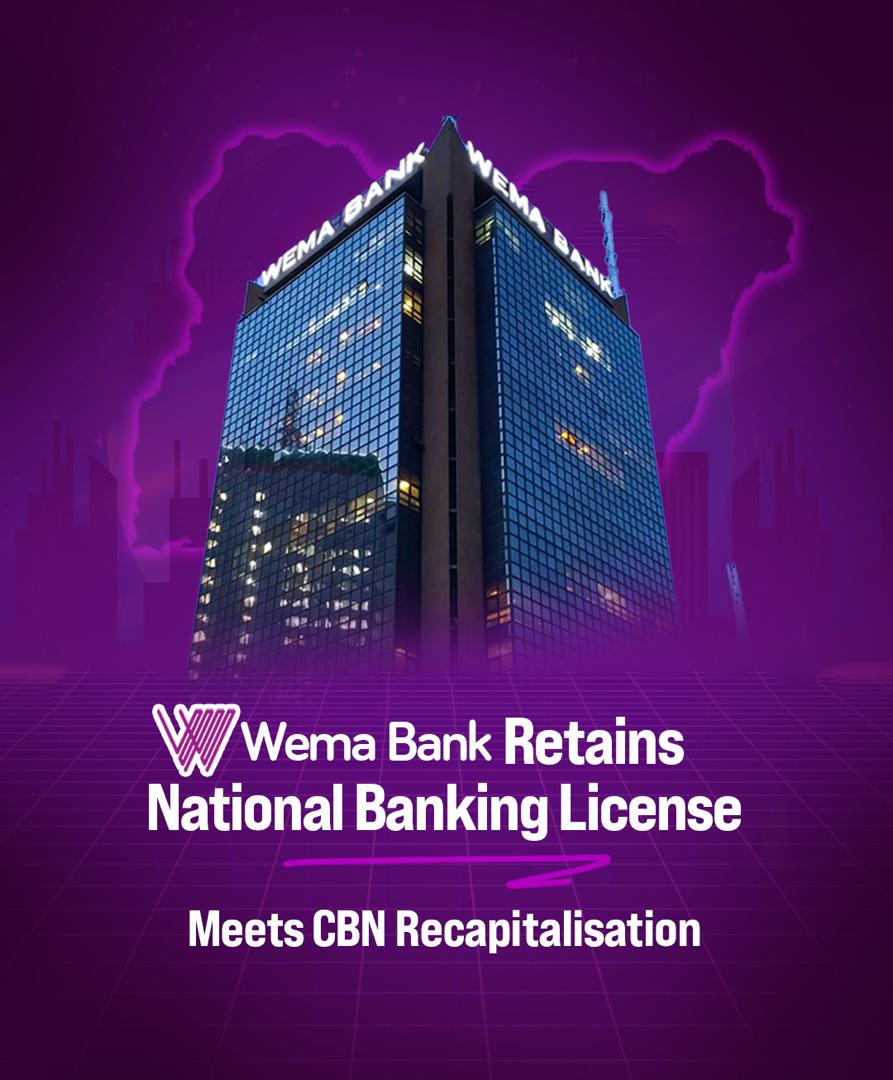
Wema Bank, Nigeria’s oldest indigenous national bank and pioneer of Africa’s first fully digital bank, ALAT, has successfully met and surpassed the Central Bank of Nigeria’s (CBN) recapitalisation requirements, reaffirming its status as a National bank. This achievement represents a critical milestone in the Bank’s growth journey, reflecting its ability to meet regulatory expectations and its deliberate strategy to scale sustainably, strengthen its balance sheet, and reinforce its position within Nigeria’s banking sector.
The milestone follows the Bank’s successful completion of a ₦150 billion Rights Issue and an additional ₦50 billion special placement in 2025, bringing its Total Qualifying Capital to ₦264.7 billion, well above the regulatory minimum. This achievement was concluded six months ahead of the CBN’s stipulated deadline, further reinforcing the Bank’s strong financial position, shareholder confidence, and long-term growth trajectory.
Earlier in April 2026, the Central Bank of Nigeria also formally confirmed that Wema Bank, alongside 32 other financial institutions across international, national, and regional categories, had successfully concluded the recapitalisation process. Notably, Wema stands among only ten national banks that met and surpassed the minimum required capital threshold, thereby sustaining its national banking license.
This milestone not only affirms regulatory compliance but also signals a new phase of accelerated growth for the Bank; one defined by stronger capital base, increased capacity to support customers, and a reinforced position within Nigeria’s competitive banking landscape.
Commenting on the milestone, the Managing Director/Chief Executive Officer of Wema Bank, Moruf Oseni, stated, “The successful completion of our recapitalisation exercise is a defining moment for Wema Bank. It is a strong validation of our strategy, our performance, and the enduring confidence our shareholders and stakeholders have in our vision. We have not only met the CBN’s requirements; we have exceeded them, reinforcing our position as a National Bank with the scale, strength, and stability to compete and lead.”
In March 2024, the Central Bank of Nigeria announced the recapitalisation programme requiring all national banks to maintain a minimum capital base of ₦200 billion. The initiative was designed to strengthen the resilience of financial institutions, enhance their capacity to absorb economic shocks, and position them to drive sustainable economic growth.
In response, Wema Bank embarked on a strategic capital raise through the stock market, successfully strengthening its shareholder base and securing the required capital through strong participation from existing investors. The ₦150 billion Rights Issue, which opened on April 14, 2025, and closed on May 21, 2025, marked a significant step in this journey. This was subsequently complemented by a ₦50 billion special placement later in the year, ensuring the Bank not only met but exceeded the regulatory threshold well ahead of schedule.
For Wema Bank, this journey is a testament to its transformation. After regaining its national license in 2015, the Bank has consistently demonstrated financial discipline and strategic foresight. By raising the necessary capital primarily from existing shareholders, the Bank has underscored a deep-seated mutual trust between the institution and its investors.
Speaking further on what this achievement means for the Bank’s future and its customers, Oseni added: “This milestone strengthens our ability to compete at scale, deepen our market presence, and deliver more value to our customers across Nigeria through improved access to credit, enhanced digital banking experiences, and innovative financial solutions. It positions us to play an even bigger role in powering Nigeria’s economy while continuing to deliver sustainable value to all our stakeholders.
Looking ahead, we remain focused on deepening our market presence, driving customer-centric innovation, and strengthening our role as a catalyst for growth across retail, SME, and corporate segments. This is not just about retaining our license; it is about building a bigger, stronger, and more impactful Wema Bank.”
The successful conclusion of the recapitalisation process underscores Wema Bank’s financial strength, disciplined execution, and unwavering commitment to regulatory compliance as it continues to expand its footprint across Nigeria. With a significantly strengthened capital base, the Bank is now positioned to do more – support more customers, enable more businesses, and unlock more opportunities across every segment it serves.
As it enters this new phase, Wema Bank is not only reaffirming its status as a National Bank; it is stepping forward with greater scale, sharper ambition, and a clear intent to lead. The Bank remains firmly committed to powering progress, driving innovation through ALAT, and delivering sustained value; powering a future of possibilities for all its stakeholders.
Banking and Finance
Banking the Economy That Actually Exists
There is a version of the Nigerian economy that the banking sector has always served well. It is the economy of salaried professionals, corporate treasurers, documented collateral, and monthly pay cycles. It is the economy that fits neatly into conventional credit models, standard account structures, and the risk frameworks that Nigerian banking inherited from its colonial and post independence institutional architecture. That economy is real, and serving it matters.
There is another version. It is the economy of the cooperative chairwoman in Ogun whose members pool contributions weekly. The textile trader in Balogun who turns inventory four times a month but has never had a formal credit history. The agro dealer in Kaduna whose working capital needs spike in planting season and collapse in the dry months. The artisan in Aba whose business has been profitable for fifteen years, but whose collateral is her workshop and her reputation. This economy is also real. It is, by most measures, larger than the first; and for most of Nigerian banking history, the sector was not designed to serve it.
The gap is not a matter of intention. It is a matter of architecture. Conventional banking products were designed around a specific customer profile: formally employed, predictable monthly income, assets that could be valued and pledged, credit history held in a bureau. Nigerians who fit that template, whether men or women, whether in Lagos or Kano, were served well. Those who did not, regardless of how productive their economic activity, were structurally underserved. They were not refused service. The products simply did not fit the shape of their lives.
The numbers confirm what anyone who has spent time in a Nigerian market already knows. According to the 2023 EFInA report, 26 per cent of Nigerian adults remain financially excluded. The World Bank’s surveys of Nigerian SMEs consistently identify access to finance as the single largest constraint on business growth, particularly among enterprises operating in the informal and semi formal sectors.
These are not idle businesses. They are enterprises generating real output and real employment, operating in a financial blind spot that the banking sector created not through malice but through product design.
A small number of institutions have begun to close that gap by building differently. Union Bank of Nigeria is one of them.
Through alpher, the bank’s financial proposition designed specifically for underserved market segments, Union Bank disbursed over ₦150 million in cash flow loans to entrepreneurs in a single three month window in 2025. The underwriting methodology behind alpher was built for businesses whose income flows through market associations and cooperative structures rather than through conventional payroll. These are businesses that traditional credit scoring cannot see, not because they are risky but because the scoring model was never calibrated for them.
Through alpher partnerships, the bank extended more than ₦106 million in discounted credit to seventy one businesses operating in market clusters that had previously sat outside the formal banking system. Its financial literacy outreach through alpher reached over 230 individuals in targeted sessions, and a parallel programme supported fifty nine previously unbanked entrepreneurs with micro grants and account opening.
The significance of these numbers is less in their volume and more in their method. alpher represents a decision to redesign the product rather than wait for the customer to fit the existing one. That is a meaningful institutional choice, because it requires a different kind of underwriting capability, a different kind of relationship management, and a different kind of patience than conventional retail or SME banking demands.
What makes Union Bank’s work on financial inclusion credible is that the institutional culture behind it is itself built on inclusion. Forty-five per cent of the bank’s board is female, exceeding the Central Bank of Nigeria’s thirty per cent governance threshold by fifteen percentage points.
The Managing Director and Chief Executive Officer, Mrs Yetunde B. Oni, leads an institution whose most recent graduate intake was sixty per cent female. The bank offers five month fully paid maternity leave, among the longest in the Nigerian banking sector, alongside ten day fully paid paternity leave, formalised adoption and surrogacy leave, and the CareCube crèche facility at the head office. These are not separate from the bank’s external inclusion work.
They are the internal architecture that makes it possible. An institution that invests in the breadth of its own talent base develops a broader product imagination than one that does not.
The honest assessment is that the Nigerian banking sector as a whole has a considerable distance still to cover. The informal and semi formal economy remains the largest segment of Nigerian economic activity, and it remains the least well served by formal financial institutions.
The products available to this segment are still too few, still too expensive in many cases, and still too narrowly distributed. Closing the gap will require more institutions to make the same architectural choice that the early movers have made: to build for the economy that actually exists, not for the economy that conventional banking assumed it was serving.
As Union Bank enters its 109th year, the inclusion question is not peripheral to its institutional story. It is central to it. A bank that has been present in Nigeria since 1917 has watched the country’s economic structure change repeatedly. The cooperative economies of the North, the trading networks of the South West, the manufacturing clusters of the South East, and the digital enterprises of Lagos each demand different financial products and different engagement models. The institutions that build for that diversity will be the ones that remain relevant. The ones that do not will find that the economy they were designed to serve is no longer the economy they need to serve.
Nigeria’s productive economy is broader, more diverse, and more resilient than any single customer profile can capture. The banking sector’s next chapter will be defined by which institutions recognised that earliest and built accordingly.
Union Bank of Nigeria has started. The work continues.
#
Banking and Finance
Fidelity Bank Extends “Give Her Power” Initiative to Ogun State, Empowers 100 Women with Vocational Tools
L-R: Regional Bank Head, Southwest 1, Fidelity Bank Plc, Mr. Folaranmi Jemirin; Commissioner for Women Affairs and Social Development, Ogun State, Hon. Adijat Adeleye-Oladapo; Head, Women Banking, Fidelity Bank Plc, Mrs. Harriba Harry-Pepple; Local Government Education Authority (LGEA) Board Chairman, Ogun State, Hon. Oluwaseyi Oyekan; and one of the beneficiaries at Fidelity Bank’s donation of vocational tools to women at the “Give Her Power” Initiative in Abeokuta, Ogun State, recently.
In a bold demonstration of its commitment to inclusive growth and sustainable development, leading financial institution, Fidelity Bank Plc has extended its recently launched “Give Her Power” initiative to Ogun State, empowering 100 women with vocational tools designed to strengthen their economic independence and boost household income.
The outreach is part of the Bank’s nationwide rollout of the initiative, which was unveiled earlier in March during the signing of strategic Memoranda of Understanding (MoUs) with partner organisations to commemorate the 2026 International Women’s Day.
The event, which held at the MKO Abiola Sports Arena in Abeokuta, featured the distribution of 50 sewing machines and 50 grinding machines to women engaged in microbusinesses across the state. It attracted market leaders, community stakeholders, and government officials, including the Ogun State Commissioner for Women Affairs and Social Development, Hon. Adijat Adeleye‑Oladapo.
Speaking at the event, the Regional Bank Head, Southwest 1, Fidelity Bank Plc, Mr. Folaranmi Jemirin, reaffirmed that the Ogun outreach aligns with the Bank’s broader commitment to delivering practical, measurable empowerment interventions through the Give Her Power initiative.
“At Fidelity Bank, our approach to empowerment is simple; it must be practical, inclusive, and sustainable. When you empower a woman economically, the benefits extend to her family, her business, and the wider community. This outreach in Abeokuta is a continuation of the momentum created with the launch of the ‘Give Her Power’ initiative earlier in March,” Jemirin stated.
He explained that the “Give Her Power” initiative is anchored on HerFidelity, the Bank’s women-focused proposition, which provides financial literacy, business support, vocational training, mentorship, and wellness initiatives for women-led enterprises.
Jemirin further revealed that the bank had scaled its women-focused interventions nationwide, including the distribution of 1,000 sewing and grinding machines, the rollout of the HerFidelity Apprenticeship Programme 2.0, financial literacy sessions for girls, mentorship engagements, and hands-on skills training.
“This is more than a donation, it’s our vote of confidence in your ability to earn, grow, and create value within your communities,” he added, urging beneficiaries to make productive use of the items.
Commending the initiative, the state commissioner for Women Affairs and Social Development, Hon. Adeleye-Oladapo, described the programme as a meaningful shift from symbolic celebrations to tangible empowerment.
“This initiative goes beyond celebrating International Women’s Day. It delivers real opportunities for transformation. When you empower a woman, you empower a family and, ultimately, society,” she stated.
She further praised Fidelity Bank for complementing the efforts of the Ogun State Government under the leadership of Governor Dapo Abiodun in advancing women’s economic empowerment.
She urged beneficiaries to make productive use of the equipment, stressing that the true value of the initiative lies in its long-term impact on livelihoods and community development.
The “Give Her Power” initiative stands out as a prime example of Fidelity Bank’s sustained commitment to building pathways for individuals to thrive, businesses to grow, and communities to prosper through inclusive empowerment programmes.
Ranked among the best banks in Nigeria, Fidelity Bank Plc is a full-fledged Commercial Deposit Money Bank serving over 10 million customers through digital banking channels, its 255 business offices in Nigeria and United Kingdom subsidiary, FidBank UK Limited.
The Bank is a recipient of multiple local and international Awards, including the 2024 Excellence in Digital Transformation & MSME Banking Award by BusinessDay Banks and Financial Institutions (BAFI) Awards; the 2024 Most Innovative Mobile Banking Application award for its Fidelity Mobile App by Global Business Outlook, and the 2024 Most Innovative Investment Banking Service Provider award by Global Brands Magazine. Additionally, the Bank was recognized as the Best Bank for SMEs in Nigeria by the Euromoney Awards for Excellence and as the Export Financing Bank of the Year by the BusinessDay Banks and Financial Institutions (BAFI) Awards.
Banking and Finance
Polaris Bank celebrates 58 New Hires from its flagship PGIT, PTIP as CEO charge them to Keep Learning, Keep Evolving
Polaris Bank MD/CEO, Kayode Lawal, engages newly graduated PGIT/PTIP cohorts, urging a steadfast commitment to continuous learning, integrity, and professional excellence at the graduation ceremony held in Lagos last Thursday.
Lagos, Nigeria — April 8, 2026: Polaris Bank has graduated 58 exceptional new hires from its flagship Polaris Graduate Intensive Training (PGIT) and Polaris Tech Ignite Programme (PTIP), reinforcing its commitment to building world-class talent in Nigeria.
The ceremony, attended by senior leadership and invited guests, celebrated a highly selective cohort drawn from over 10,000 applicants – placing them among the top 0.58% who successfully made the cut. The milestone underscores the bank’s rigorous standards in identifying and grooming future leaders.
Addressing the graduates, Managing Director/CEO, Mr. Kayode Lawal, delivered a compelling charge centered on continuous learning and adaptability in a fast-evolving industry. “Never stop learning, because life never stops teaching,” he said. “In today’s technology-driven world, staying relevant requires constantly upgrading your skills. The world has moved from a pre-digital era to one powered by AI – where tasks that once took weeks are now completed in minutes. To thrive, you must learn, adapt, and evolve.”
He also stressed the primacy of character, noting that integrity remains the cornerstone of a successful banking career. “Integrity is the hallmark of a banker – once you lose it, you lose everything. What we truly sell is our reputation,” he stated, urging the graduates to uphold the highest ethical standards.
Mr. Lawal further encouraged disciplined financial habits, humility, and gratitude, reminding them that success goes beyond professional milestones to include lifelong learning, strong values, and respect for those who support one’s journey.
Congratulating the cohort, he urged them to embrace their careers with purpose and responsibility, noting that their contributions will be pivotal to the bank’s growth and the broader financial ecosystem.
The PGIT and PTIP programmes offer intensive training across banking and technology disciplines and have consistently produced high-performing professionals. The new hires will be deployed across key functions, supporting Polaris Bank’s strategic priorities in retail expansion, digital innovation, and superior customer experience.
Polaris Bank remains committed to empowering young Nigerians with opportunities to build impactful careers, as it continues to foster a culture of excellence, innovation, and sustainable growth within the financial services sector.
–
-
Business and Brand3 hours agoVerve Partners NEXO Standards Community, PCI Security Standards Council To Secure Global Interoperable Payments
-
Cover1 day agoKwara Monarch Kidnap: Primate Ayodele Warned But They Didn’t Listen
-
Banking and Finance1 day agoBanking the Economy That Actually Exists
-
Entertainment3 hours agoPremium Entertainment Without the Premium Price Tag