


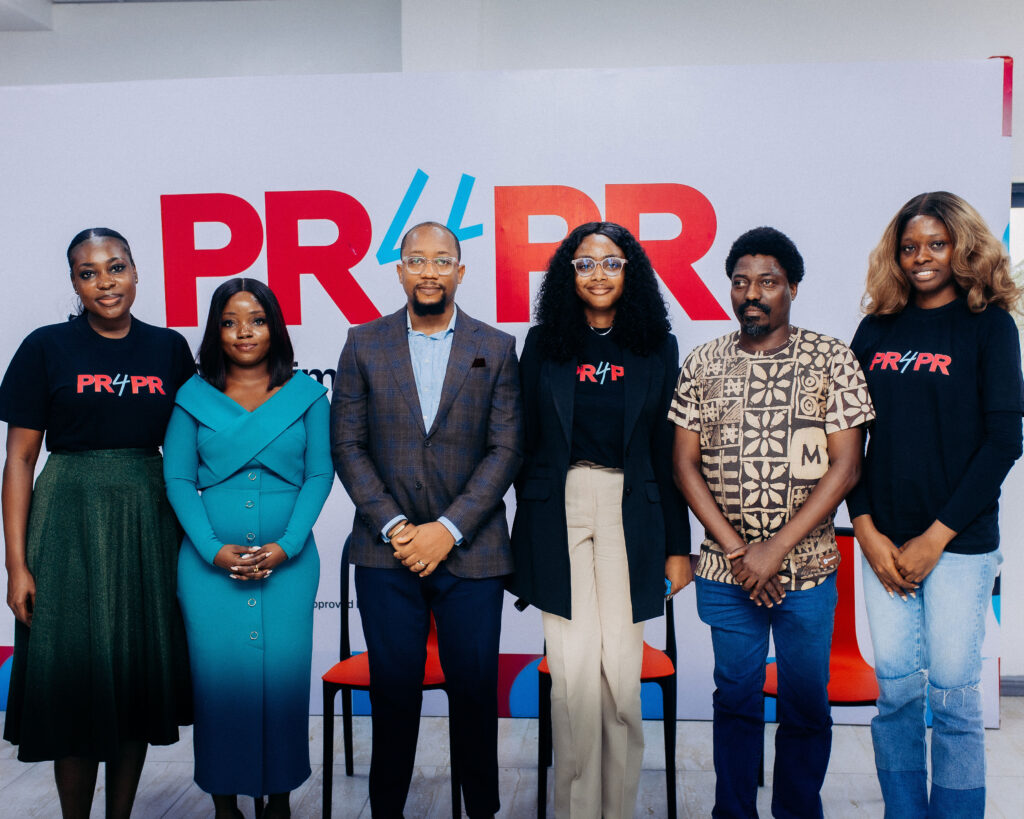
PHOTO CAPTION:From left: Mobola Akintola, Co-convener; Berlinda Adebanwo, Marketing Manager, Corporate & Investment Banking, Stanbic IBTC; Adebowale Banzi, Team Lead, Media & Internal Communications, Fidelity Bank Plc; Erhuvwu Akpomerha, Co-convener; Bemigho Awala, Communications Professional and PR & Media Relations Specialist,; and Adepeju Ogungbenle, Co-convener, at PR4PR, an initiative by MSc Media and Communication students of Pan-Atlantic University aimed at highlighting the value, scope and strategic importance of Public Relations in Nigeria.NOTE: The Event took place in Lagos recently.
Where does Public Relations end and marketing or advertising begin? It is a distinction that communication professionals may understand in theory, yet one that can become less clear in practice as organisations bring different communication disciplines together to solve business problems.
That tension took centre stage at the PR4PR Roundtable, held on Saturday, 17 October 2026 at the Nike Davies Okundaye Auditorium, Ananse Center for Design Lagos, Lekki. The student-led public education initiative was created to stimulate clearer conversations about what Public Relations is, what it is not, and the value it contributes to organisations.
One of the day’s central sessions, “PR in Practice”, brought together Berlinda Adebanwo, Bemigho Awala and Adebowale Banzi for a fireside conversation designed to explore the practical distinctions between PR, marketing and advertising, alongside the realities communicators face within organisations.
For Berlinda Adebanwo, practitioners seeking greater influence within organisations must demonstrate an understanding of the wider environment in which business decisions are made. “PR practitioners earn strategic relevance when they understand the business beyond communications. You have to know the numbers, understand the policies and be able to challenge decisions with informed perspectives. When stakeholders see that you understand what matters to the business and can contribute meaningfully to those conversations, they begin to regard you as a strategic adviser rather than simply the person responsible for communications,” Berlinda Adebanwo said.
Adebowale Banzi placed trust at the heart of PR measurement. “For PR, the most important measure is trust. Reach and visibility may tell us how many people encountered a message, but the bigger question is whether people trust the organisation behind it. When trust exists, it strengthens the relationship between an organisation and its stakeholders, and that is where PR creates lasting value,” Adebowale Banzi said.
The point speaks to a longstanding challenge for PR practitioners: demonstrating impact in terms organisations recognise without reducing the discipline entirely to metrics more commonly associated with marketing and advertising.
Bemigho Awala brought a career-development perspective to the discussion, encouraging emerging practitioners to consider agency experience as a means of broadening their professional knowledge and exposure, particularly at a time when many professionals aspire to transition to client-side roles. “Young practitioners should not be too quick to overlook agency experience in the race to move to the client side. Agency work gives you exposure to different clients, industries and communication challenges, and that breadth of experience can significantly strengthen how you approach PR as your career develops,” Bemigho Awala said.
The fireside conversation formed part of a wider programme that included a keynote address by Bolaji Abimbola, the “PR in View” session by Adaoha Njemanze, and an academic address by Adeyinka Igbinoba.
For the Co-conveners, bringing these different perspectives together was intentional, particularly because PR4PR was conceived to address persistent confusion around the identity and value of Public Relations.
Co-convener Erhuvwu Akpomerha said the conversations demonstrated the need to move beyond textbook definitions and consider what PR actually looks like in practice. “One of the reasons we created PR4PR was to move the conversation beyond textbook definitions and examine what PR looks like in practice. Greater clarity about what PR contributes will help practitioners better understand their role and help organisations commission the right work and recognise the value being created,” Akpomerha said.
Co-convener Adepeju Ogungbenle reflected on the responsibility of practitioners to translate their understanding of PR into tangible relevance within the organisations and industries they serve. “Understanding what makes PR distinct is important, but practitioners must also be able to translate that understanding into value for the organisations they advise. That means understanding the business, its stakeholders and priorities, and being able to demonstrate where PR contributes strategically,” Ogungbenle said.
For Co-convener Mobola Akintola, greater clarity about PR’s identity is equally important to developing practitioners who understand the purpose of their profession and can represent it effectively. “Clarity about the identity of PR is also important to the development of practitioners themselves. When professionals understand what the discipline represents and the value it is expected to create, they are better positioned to practise with purpose and communicate that value to clients and organisations,” Akintola said.
The event brought together around 100 participants across its physical and online audiences, creating a platform for students, emerging practitioners and industry professionals to engage with conversations around the practice and positioning of Public Relations. PR4PR was convened by Erhuvwu Akpomerha, Adepeju Ogungbenle and Mobola Akintola. This project was carried out as the Co-conveners’ Project Based Internship (PBI) as MSc Media and Communication students of Pan-Atlantic University.